What Is Hydrogen Peroxide Solution?
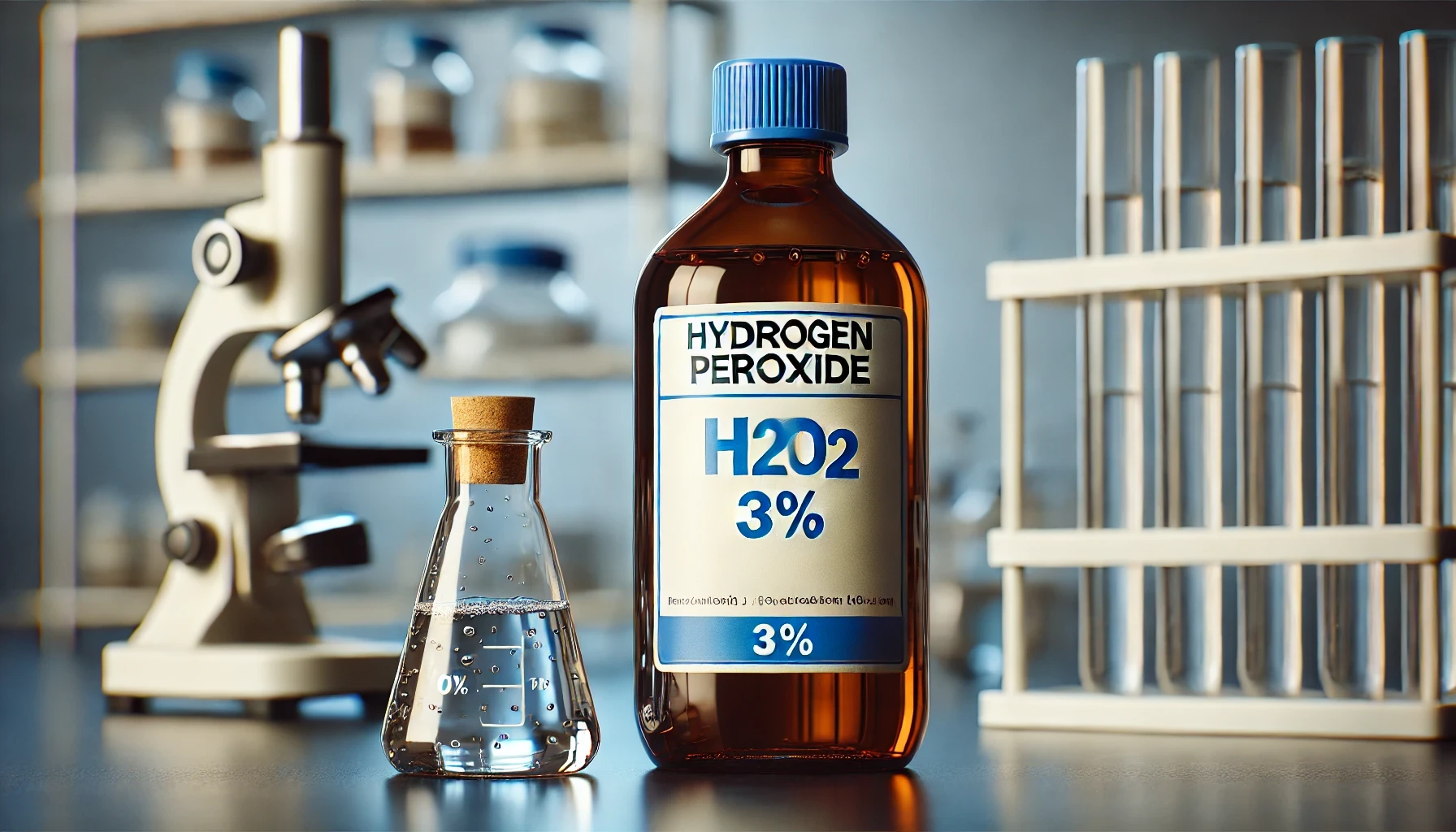
What is Hydrogen Peroxide Solution?
This post was written with Consensus AI Academic Search Engine - please read our Disclaimer at the end of this article. Hydrogen peroxide (H₂O₂) is a versatile chemical compound widely used in various applications, ranging from medical treatments to industrial processes. This article explores the properties, uses, and safety considerations of hydrogen peroxide solutions.
Chemical Properties
Hydrogen peroxide is a pale blue liquid in its pure form and is slightly more viscous than water. It is a weak acid and has strong oxidizing properties, making it a powerful bleaching agent. The compound decomposes into water and oxygen, a reaction catalyzed by the enzyme catalase, which is present in many biological tissues4.
Medical Applications
Hydrogen peroxide is commonly used in medical settings for its antiseptic properties. It is often applied to clean wounds, as it helps to remove contaminants and has some germicidal effects. When applied to tissues, hydrogen peroxide decomposes rapidly, releasing oxygen bubbles that help to mechanically clean the wound2. Additionally, high-concentration hydrogen peroxide solutions, such as A-101, have been shown to be effective in treating seborrheic keratosis, a common benign skin tumor1.
Industrial and Laboratory Uses
In industrial applications, hydrogen peroxide is used for bleaching textiles and paper, as well as in the manufacture of various chemicals. It is also employed in environmental applications, such as wastewater treatment, due to its ability to break down organic pollutants.
In laboratory settings, hydrogen peroxide is used in various analytical techniques. For instance, it can be determined spectrophotometrically by its reaction with copper (II) ions to form a copper (I)-DMP complex, which can be measured at 454 nm3. Another method involves its reaction with potassium hexacyanoferrate(III) in an alkaline solution, which can be measured at 418 nm7.
Safety Considerations
While hydrogen peroxide is useful, it also poses certain hazards. High concentrations can cause skin burns and eye damage. In medical settings, improper use, such as irrigation under pressure or into enclosed body cavities, can lead to serious complications like oxygen embolus and surgical emphysema2. Therefore, it is crucial to handle hydrogen peroxide with care and follow safety guidelines.
Recent Advances
Recent research has focused on improving the synthesis and stability of hydrogen peroxide solutions. For example, a direct electrosynthesis method has been developed to produce pure aqueous hydrogen peroxide solutions without the need for post-reaction purification. This method uses a solid-state electrolyte to combine electrochemically generated H⁺ and HO₂⁻ ions, achieving high selectivity and productivity5. Additionally, innovative electrochemical methods have been introduced to produce electrolyte-free hydrogen peroxide solutions, which are safer and more efficient for distributed manufacturing8. Learn more with Consensus: [button icon="🤕" text="Is hydrogen peroxide used for cleaning wounds in medical settings?"][/button] [button icon="🦶🏼" text="Can high concentrations of hydrogen peroxide cause skin burns?"][/button]
Uses of Hydrogen Peroxide Solution
Medical and Therapeutic Uses Expectorant and Mucolytic Agent: Hydrogen peroxide in alkaline solutions can break down thick pus, mucus, sputum, and blood, making it useful for treating purulent diseases, hematomas, and bruising1 8. Antihypoxant: Hydrogen peroxide can increase oxygen content in tissues, serving as an alternative to arterial blood for oxygen-deficient tissues2. Wound Cleaning and Antiseptic: It is commonly used for irrigating and cleaning wounds due to its germicidal properties and ability to mechanically remove contaminants3 4. Disinfection and Sterilization Broad-Spectrum Antimicrobial: Hydrogen peroxide is effective against a wide range of microorganisms, including bacterial spores, protozoal cysts, and prions. It is used in both liquid and gas forms for disinfection and sterilization4. Food Industry: It is used for sterilizing packaging materials in the food industry, particularly for dairy products7. Industrial and Environmental Applications Bleaching Agent: Hydrogen peroxide is used as an industrial bleach for wood, paper, textiles, leather, and even seafood. It is also used in combination with sodium bicarbonate for bleaching and cleaning surfaces contaminated with blood and pus1 8. Advanced Oxidation Processes: It is used in combination with UV light to treat trace organic contaminants in water treatment systems6. Innovative and Emerging Uses Sustainable Fuel: Hydrogen peroxide can be produced electrochemically and used as a fuel in fuel cells, demonstrating its potential as a sustainable energy source9. Learn more with Consensus: [button icon="⚙️" text="What are the uses of hydrogen peroxide solution?"][/button]
Adverse Effects of Hydrogen Peroxide Solution
Oxygen Embolism and Surgical Emphysema Application of hydrogen peroxide under pressure or into enclosed body cavities can lead to serious complications such as oxygen embolus and surgical emphysema1 10. Tooth Sensitivity and Cervical Root Resorption Tooth whitening with hydrogen peroxide can cause tooth sensitivity in 15-78% of patients and cervical root resorption, especially with thermo-catalytic procedures4 7. Genotoxicity and Carcinogenicity Direct contact with hydrogen peroxide can induce genotoxic effects in bacteria and cultured epithelial cells. There is potential for hydrogen peroxide to act as a carcinogen, although this is not conclusively proven in clinical settings4 7. Mild and Transient Local Skin Reactions High-concentration hydrogen peroxide solutions used for treating seborrheic keratosis can cause mild and transient local skin reactions, but these are generally well-tolerated9. Cytotoxic Effects on Cells Hydrogen peroxide can cause cytotoxic effects on odontoblast and osteoblast cell lines, leading to increased reactive oxygen species (ROS) and potential damage to cellular structures6. Adverse Effects in Dogs When used to induce emesis in dogs, hydrogen peroxide can cause mild and self-limiting adverse effects5. Severe Clinical Reactions Reports indicate severe adverse effects such as hypersensitivity, pneumocerebral complications, myocardial injury, pulmonary gas embolism, and cardiac arrest, which can occur suddenly and have fatal outcomes8. Learn more with Consensus:
[button icon="💥" text="What are the adverse effects of hydrogen peroxide solution?"][/button]
[button icon="🧴" text="Is hydrogen peroxide associated with cytotoxic effects on cell lines such as odontoblasts and osteoblasts?"][/button]
How has Hydrogen Peroxide Solution Improved Patient Outcomes?
COVID-19 Treatment Nebulized hydrogen peroxide significantly reduced viral load and disease severity in moderately sick COVID-19 patients, leading to better outcomes in terms of oxygen requirement and symptom resolution1. Hydrogen peroxide as a mouthwash and nasal spray showed no significant difference in symptom severity or hospital stay length for COVID-19 patients, though it was deemed safe to use2. Surgical Site Preparation Adding hydrogen peroxide to preoperative skin preparation significantly reduced the rate of Cutibacterium acnes-positive cultures in shoulder surgery, particularly in male patients3 9. Hydrogen peroxide skin preparation reduced intraoperative culture positivity for Cutibacterium acnes in shoulder arthroplasty, suggesting it may lower deep tissue contamination3. Periodontal Treatment Weekly supragingival irrigation with aerosolized hydrogen peroxide significantly improved clinical and microbiological parameters in patients with chronic periodontitis compared to mechanical debridement alone4. Contact Lens Cleaning A novel hydrogen peroxide cleaning solution for contact lenses showed high levels of patient satisfaction, particularly in terms of comfort, moisture, and cleanliness5. Hospital Disinfection Hydrogen peroxide vapor for room disinfection significantly reduced Clostridium difficile infection, vancomycin-resistant enterococci, and extended-spectrum β-lactamase-producing bacteria7. Improved hydrogen peroxide disinfectant reduced surface contamination and a composite health care outcome measure compared to quaternary ammonium-based disinfectants6. Hydrogen peroxide fogging in operating rooms significantly decreased surgical site infection rates and increased the interval between infections10. Learn more with Consensus:
[button icon="🧑" text="How has hydrogen peroxide solution improved patient outcomes?"][/button]
[button icon="💪" text="Is hydrogen peroxide an effective component of preoperative skin preparation for shoulder surgeries?"][/button]
Hydrogen Peroxide Solution Mechanisms of Action
Oxidation of Cellular Components Hydrogen peroxide acts by chemically oxidizing cellular components such as DNA, proteins, and membrane lipids. This oxidation is primarily driven by the production of free hydroxyl radicals through the Fenton reaction, which involves the interaction of hydrogen peroxide with iron2 4. Nucleophilic Displacement In the oxidation of hydrogen sulfide (H₂S) and hydrosulfide ions, hydrogen peroxide undergoes a nucleophilic displacement reaction, forming polysulfide intermediates. This reaction is influenced by the pH of the solution, with specific rate laws governing the process1. Biocidal Efficacy The efficacy of hydrogen peroxide as a biocide varies between its liquid and gaseous forms. Gaseous hydrogen peroxide is a more potent oxidizer of proteins and other macromolecules compared to its liquid form, leading to greater antimicrobial activity2 4. Temperature and Alkalinity Effects The activity of hydrogen peroxide solutions is enhanced by increasing the temperature and alkalinity of the solution. Higher temperatures and alkaline conditions accelerate the decomposition of hydrogen peroxide into water and oxygen, which increases its pyolytic, mucolytic, hemolytic, and bleaching effects. This process also reduces the viscosity of biological masses, making them more permeable to the antiseptic solution3. Oxidation of Organic Sulfides The oxidation of organic sulfides by hydrogen peroxide involves the breaking of the O-O bond in H₂O₂ and the formation of an S-O bond. This process is facilitated by hydrogen bonding with water molecules, which stabilizes the activation complex. The reaction does not show significant pH dependence within a moderate range around neutral pH5. Learn more with Consensus: [button icon="🎡" text="What is hydrogen peroxide solution mechanism of action?"][/button]
Common Complaints Associated with Hydrogen Peroxide Solution Use
Tissue Damage and Oxygen Embolism Hydrogen peroxide can cause serious tissue damage and oxygen embolism when used for wound irrigation, especially under pressure or in enclosed body cavities1 3 6. Gastrointestinal Irritation and Damage Ingestion of hydrogen peroxide, even in low concentrations (3%), can lead to gastrointestinal irritation, including symptoms like nausea, vomiting, and abdominal pain. Severe cases can result in chemical gastritis and colitis2 3. Central Nervous System Damage Ingestion of hydrogen peroxide can cause severe central nervous system damage due to arterial gas embolism, potentially leading to brain infarction and even brain death in extreme cases3 4. Respiratory and Pulmonary Issues Inhalation of hydrogen peroxide can cause respiratory tract irritation, coughing, and in severe cases, pulmonary edema. Ingestion can also lead to respiratory complications due to foam formation obstructing the airways3. Dermal and Ocular Irritation Contact with hydrogen peroxide can cause skin irritation, blistering, and severe skin damage. Ocular exposure, even to low concentrations (3%), can result in stinging, irritation, and blurred vision, with higher concentrations causing more severe damage3 5. Learn more with Consensus: [button icon="😞" text="Can hydrogen peroxide ingestion lead to central nervous system damage?"][/button] [button icon="🧏🏻♀️" text="Is hydrogen peroxide a common cause of dermal irritation when applied to the skin?"][/button]
Disclaimer
The content presented in this blog is generated by Consensus, an AI-powered academic search engine, and is based on publicly available scientific literature. While every effort is made to provide accurate, up-to-date, and well-researched information, the content is intended for informational and educational purposes only. It does not constitute medical advice, diagnosis, or treatment. Always consult a qualified healthcare professional before making any decisions regarding medical conditions, treatments, or medications. The AI system's analysis may not cover all perspectives, emerging research, or individual cases, and it is not a substitute for professional expertise. Neither the blog publisher nor the developers of the AI-powered search engine are responsible for any actions taken based on the information provided in this content. Use of this information is at your own risk. Citations to the original scientific studies are included for reference, but these studies should be reviewed in full and interpreted with the guidance of a healthcare or research professional. If you are experiencing a medical emergency, please seek immediate attention from a healthcare provider.
Start searching for free in Consensus!
Consensus searches through 220M+ peer reviewed research papers and provides you the best insights from them. Helping you find better papers, faster.

Sign Up