
From the editor
For decades there was minimal progress against pancreatic cancer, largely because the molecule that drives it, RAS, was considered undruggable. That changed on August 26th, when the FDA approved daraxonrasib as the first targeted therapy for metastatic pancreatic cancer. In the trial behind the approval, median survival roughly doubled, and when the results were presented at the biggest medical conference in the world the room gave them a standing ovation. Here’s how it happened…
The breakthrough
RAS is the most commonly-mutated oncogene in pancreatic cancer — it’s mutated in ~90% of cases, where it drives aggressive disease and poor outcomes. RAS is the prototype ‘undruggable’ protein: it’s a small, smooth molecule, which is a problem for drug development, because there’s no obvious pocket for a drug to slot into. This means that, until very recently, there were no approved RAS inhibitors for pancreatic cancer, and the mainstay of treatment was chemotherapy.
RAS does sometimes expose a druggable pocket — when it’s inactive, in its ‘off’ state. There are a couple of RAS inhibitors that do this (sotorasib and adagrasib, approved in colorectal and lung cancer) both of which target the G12C mutant. But the G12C mutant only composes a small fraction of RAS mutants, and mutant RAS spends most of its time in its active (on) state — not the off state — which limits the efficacy of these drugs.
To drug the ‘on’ state, you’d need a drug small enough, with high enough affinity, to displace GTP. Given the picomolar affinity with which GTP binds to RAS, and its high concentration in the cell, this has always been the major blocker for drug development.
Revolution Medicines, a biotech company in California, got creative with a different approach.
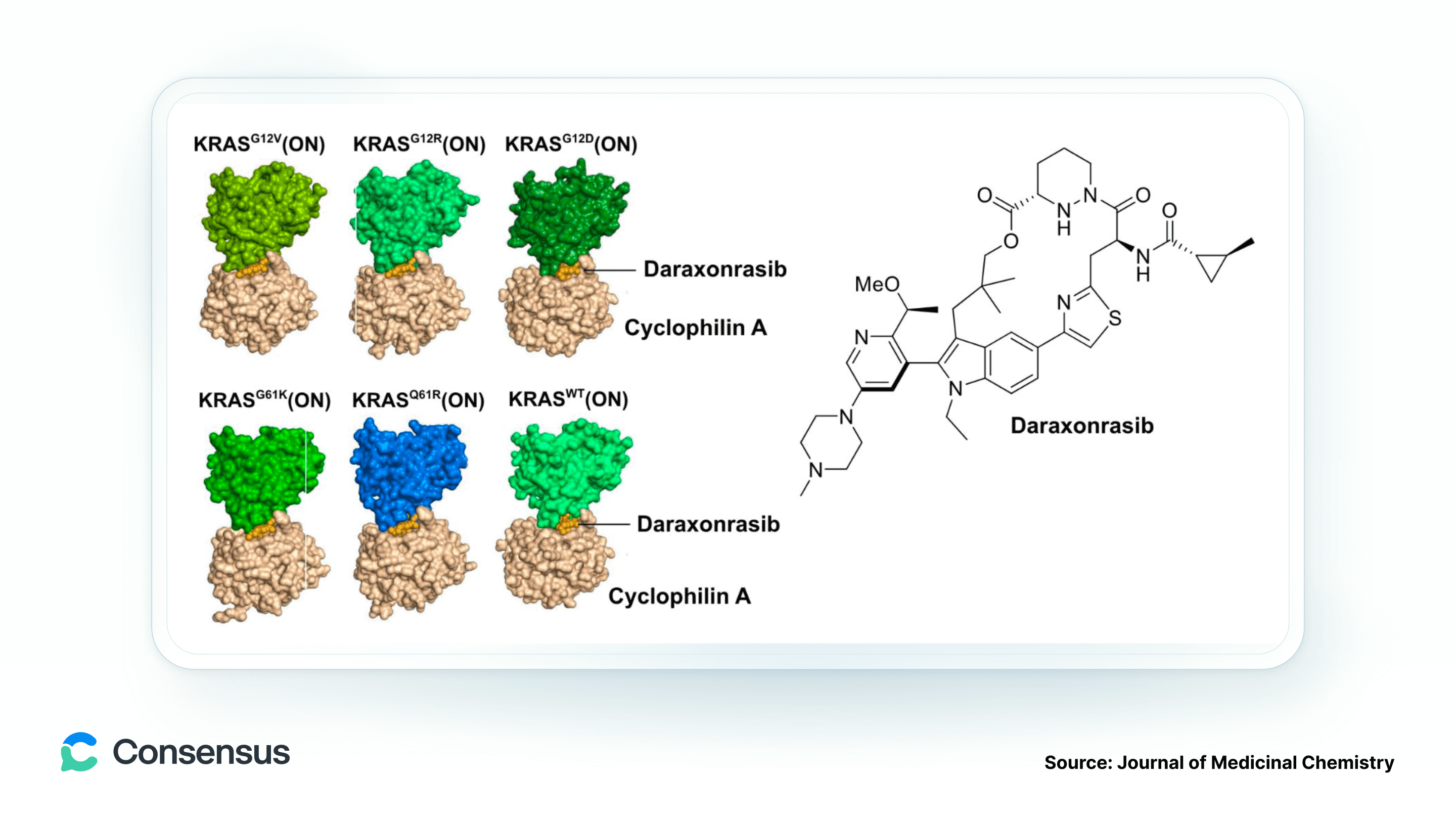
Their lead compound is daraxonrasib, a ‘molecular glue’ that binds to a scaffolding protein (called cyclophilin A) and then active (on) RAS. This trimer locks RAS into a state that’s unable to activate the downstream pathway. This also gives rise to its name: darax-ON-RAS-ib. As a pan-RAS inhibitor, it blocks multiple mutant RAS species, including G12D, G12V, G12C, G13X and Q61X, providing benefit for a much wider range of patients than G12C inhibitors.
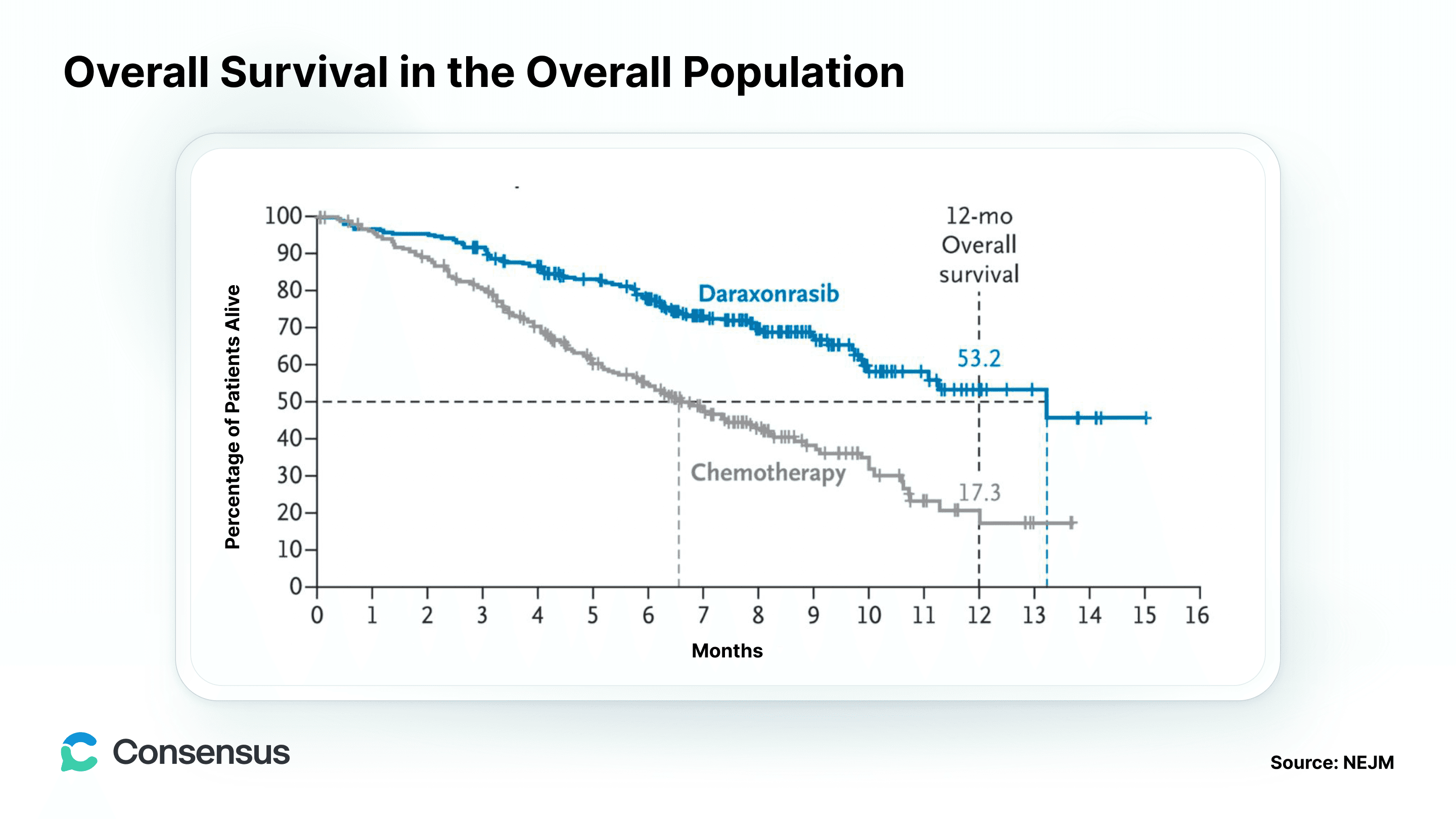
The major phase 3 trial data for daraxonrasib (in second line metastatic pancreatic cancer) were presented at the American Society of Clinical Oncology meeting, the biggest medical conference in the world. Daraxonrasib doubled survival vs. standard of care chemotherapy, improved quality of life and reduced pain associated with pancreatic cancer. Upon seeing the Kaplan-Meier curve, the crowd interrupted Dr. Wolpin’s talk with a standing ovation. I was in the room – it was inspirational, to put it mildly.
Daraxonrasib was approved by the FDA on August 26th, under the brand name RASONQUE — for patients with metastatic pancreatic adenocarcinoma who have received at least one prior systemic therapy, or who are not candidates for multiagent chemotherapy. It is the first targeted therapy approved in this setting.
Targeting specific RAS mutations
Daraxonrasib isn’t perfect, though – it also inhibits the wildtype RAS that normal cells – like skin cells – express, so it often causes a rash (with a total prevalence of 90%, ~14% of which are grade 3+).
An alternative approach would be specific inhibitors of mutations exclusively present in cancer, like RAS G12D, which affects ~35–40% of all pancreatic cancer patients. These are the commonest RAS mutations, and also correlate with worse survival. Revolution Medicines are tackling RAS G12D, too, with zoldonrasib (zold-ON-RAS-ib) which works in a similar way to daraxonrasib: it’s a tricomplex molecular glue, that inhibits the active form of RAS G12D. Indeed, in trials, the incidence of rash with zoldonrasib is much lower than with daraxonrasib (~18% vs. ~90%).
Combination therapy with multiple RAS inhibitors
The RAS breakthrough has delivered not only a targeted treatment, but also a new foundation of therapy in pancreatic cancer – to be built on with combination therapies.
Because daraxonrasib and zoldonrasib bind different parts of the RAS protein, giving them together seems to be better than either alone. This deepens RAS inhibition – and they seem to anticipate each other's resistance mechanisms. Daraxonrasib already doubles average survival vs. standard care chemotherapy, but if daraxonrasib and zoldonrasib are used together, responses are even stronger.
Combination therapy with synthetic lethal approaches
Beyond RAS, we are now starting to break pancreatic cancer down into its molecular constituents – building on RAS inhibitors as the foundation.
Tango Therapeutics is a Boston company working on synthetic lethality, which describes a concept where two defects that are tolerable separately are lethal together — this is useful to target cancer cells (which often inactivate genes as they transform) while sparing normal cells.
The hottest and most promising emerging synthetic lethal interaction is between MTAP and PRMT5. About 40% of pancreatic cancers are deficient in the metabolic enzyme MTAP, which clears a metabolite called methylthioadenosine (MTA). Tango’s approach is rooted in a couple of pre-clinical discoveries, which found that these MTAP-deficient cancers accumulate MTA, partly suppressing an epigenetic enzyme, PRMT5 – and making tumor cells hypersensitive to pharmacological PRMT5 inhibition. PRMT5 is an essential gene; without it, cancer cells die.
These data are still early, but in MTAP-deficient pancreatic cancer, a PRMT5 inhibitor-daraxonrasib combination achieves an objective response rate of 92% (compared with 20-32% with daraxonrasib alone, and 11% with the current standard-of-care chemotherapy).
The synthetic lethality itself is independent of RAS, but I think this layering of therapy – targeting different molecular drivers alongside RAS – will get more elaborate and continue to improve outcomes.
The future: prevention of pancreatic cancer
The elephant in the room with the above is that it’s about metastatic pancreas cancer, which accounts for 50% of new diagnoses. But what if we could prevent it in the first place?
Pancreas cancer develops from normal tissues via well-established precursor lesions, which usually express the dominant driver in pancreas cancer (mutant RAS), are often visible on imaging — and are present for many years before progression. This means the case for a vaccine against mutant RAS — to intercept pancreas cancer before progression — is a compelling one.
An academic group from Johns Hopkins (whose technology has now been licensed to Adventris Pharmaceuticals) built a vaccine against a mixture of six RAS mutants: G12D, G12V, G12R, G12C, G12A and G13D. In a trial of 20 people with familial pancreatic cancer risk plus a radiographic pancreatic abnormality (a precursor lesion), 90% of participants developed mutant RAS-specific responses, many of which were durable.
Whether this actually prevented pancreatic cancer isn’t yet known and this is a small 20-person, single-arm phase 1 trial, but it’s a huge step in the right direction towards a future where pancreatic cancer prevention is possible. For it to be widely successful, we’ll need a better way to detect precursor lesions, and a better way to distinguish high-risk from low-risk precursors.
Conclusions
Pancreatic cancer is being transformed from a chemotherapy-only disease into a disease with a pipeline of molecularly targeted therapies, with RAS inhibition as the foundation.
Given the high conviction nature of RAS, a stack of mechanisms is building up around it – hitting the target in multiple ways: not only pan-RAS inhibitors, mutant-selective RAS(OFF) inhibitors, and mutant-selective RAS(ON) inhibitors – as discussed here – but also ON/OFF inhibitors and even RAS degraders. With mutant RAS-targeting vaccines, we might even be moving towards pancreatic cancer prevention: the RAS revolution is in full flow.
About the Author:
Dr. Samuel Hume is a clinician-scientist. He writes on X and Substack, and interviews founders, scientists and drug hunters on YouTube. He’s interested, mainly, in preventative medicine, cancer, and drug discovery.
Learn more
What do recent trials show about KRAS inhibitors for metastatic pancreatic cancer?
Which combination therapies look most promising alongside KRAS inhibition?
Could KRAS-targeted vaccines help prevent pancreatic cancer in high-risk patients?
Key references
O’Reilly EM, Wainberg ZA, Hendifar AE, et al. Daraxonrasib or Chemotherapy in Previously Treated Metastatic Pancreatic Cancer. N Engl J Med. 2026.
DOI: https://doi.org/10.1056/NEJMoa2605555
Cregg J, Edwards AV, Chang S, et al. Discovery of Daraxonrasib (RMC-6236), a Potent and Orally Bioavailable RAS(ON) Multi-selective, Noncovalent Tri-complex Inhibitor for the Treatment of Patients with Multiple RAS-Addicted Cancers. J Med Chem. 2025;68.
DOI: https://doi.org/10.1021/acs.jmedchem.4c02314
Garrido-Laguna I, et al. Preliminary safety, antitumor activity, and circulating tumor DNA changes with RMC-9805 [zoldonrasib], an oral RAS(ON) G12D-selective tri-complex inhibitor in patients with KRAS G12D pancreatic ductal adenocarcinoma. J Clin Oncol. 2025;43(suppl):724.
DOI: https://doi.org/10.1200/JCO.2025.43.4_suppl.724
Tango Therapeutics. Vopimetostat + RAS(ON) inhibitor Phase 1/2 clinical data. June 2026.
Haldar SD, Huff AL, Wang HH, et al. First-in-human testing of a mutant KRAS vaccine for pancreatic cancer interception in high-risk cohorts. Cancer Discovery. 2026.
DOI: https://doi.org/10.1158/2159-8290.CD-25-2245
Image credit: RAS protein illustration by David S. Goodsell, RCSB Protein Data Bank, Molecule of the Month: Ras Protein (April 2012). doi:10.2210/rcsb_pdb/mom_2012_4. Licensed under CC BY 4.0.