
Finding Purpose: Beatriz Costa Ferreira’s Path to Psychology Research
From São Paulo's Subway System to Health Psychology Research
A Spark in the Subway
Beatriz Costa Ferreira's path into psychology began at 15, when she took a job at São Paulo's subway system helping blind commuters navigate the city. The work quietly answered a question she hadn't yet known to ask: she wanted to understand what people feel, not just what ails them. That instinct drew her toward psychology and, inspired by her mother's example as a researcher, toward the science of chronic illness. Now a final-year undergraduate at the University of São Judas Tadeu with one published paper, another under journal review, and a third in progress, she hasn't stopped since. "When I like something, I can't stop," she says.
Understanding Wounds Beyond the Surface
Beatriz is a final-year psychology student at the University of São Judas Tadeu, conducting her research at the University of São Paulo. There, she focuses on the stress and coping mechanisms of patients with hard-to-heal wounds.
Beatriz's research focuses on something most people would rather not think about: what happens, psychologically, when a wound simply won't heal. What started as a case series of 10 patients grew into a cohort study of 32 Brazilians, and eventually into a cross-national comparison between Brazil and Canada, where she spent a semester on a scholarship. The findings surprised her. Patients whose wounds were not healing were actually reporting lower stress than those who were recovering. After living with their wounds for years, sometimes decades, they had stopped fighting them. They had adapted.

That discovery is now driving her thesis, a qualitative study into what hard-to-heal wounds mean to the people carrying them, and what that meaning reveals about the psychology of chronic illness more broadly. It points toward the career she is building: health psychologist, outpatient clinic advocate, and eventually, she hopes, someone who helps shape public health policy inside Brazil's national health system. "In hospitals, you are just a number, just a disease," she says. "We need to look at the person."
A Smarter Way to Search the Literature
For most of her research life, Beatriz relied on the tools everyone uses: Google Scholar, PubMed, the traditional databases. What frustrated her was the precision they demanded. You had to already know the right word, the right phrase, the right way to frame a question that was still taking shape in your mind. Consensus changed that. She could write out her research question the way she would explain it to a colleague, and the tool would meet her there. For a researcher who works across Portuguese and English every day, that flexibility matters more than it might seem.

Beatriz's Workflow
Before she opens Consensus, Beatriz defines the main topics she wants to cover in her research. Once she has those topics in mind, she uses Consensus as her first stop, searching each one in turn, starting broad and then narrowing down based on what the results spark in her, zeroing in on the specific angles and questions she wants to explore further. When researching mental health and wound healing, for example, she types that phrase directly into Consensus, filters the results by relevance, and uses the summaries to decide which papers are worth going deeper into before selecting the ones she wants to read or listen to in full. From there, she builds her own critical perspective before moving forward.
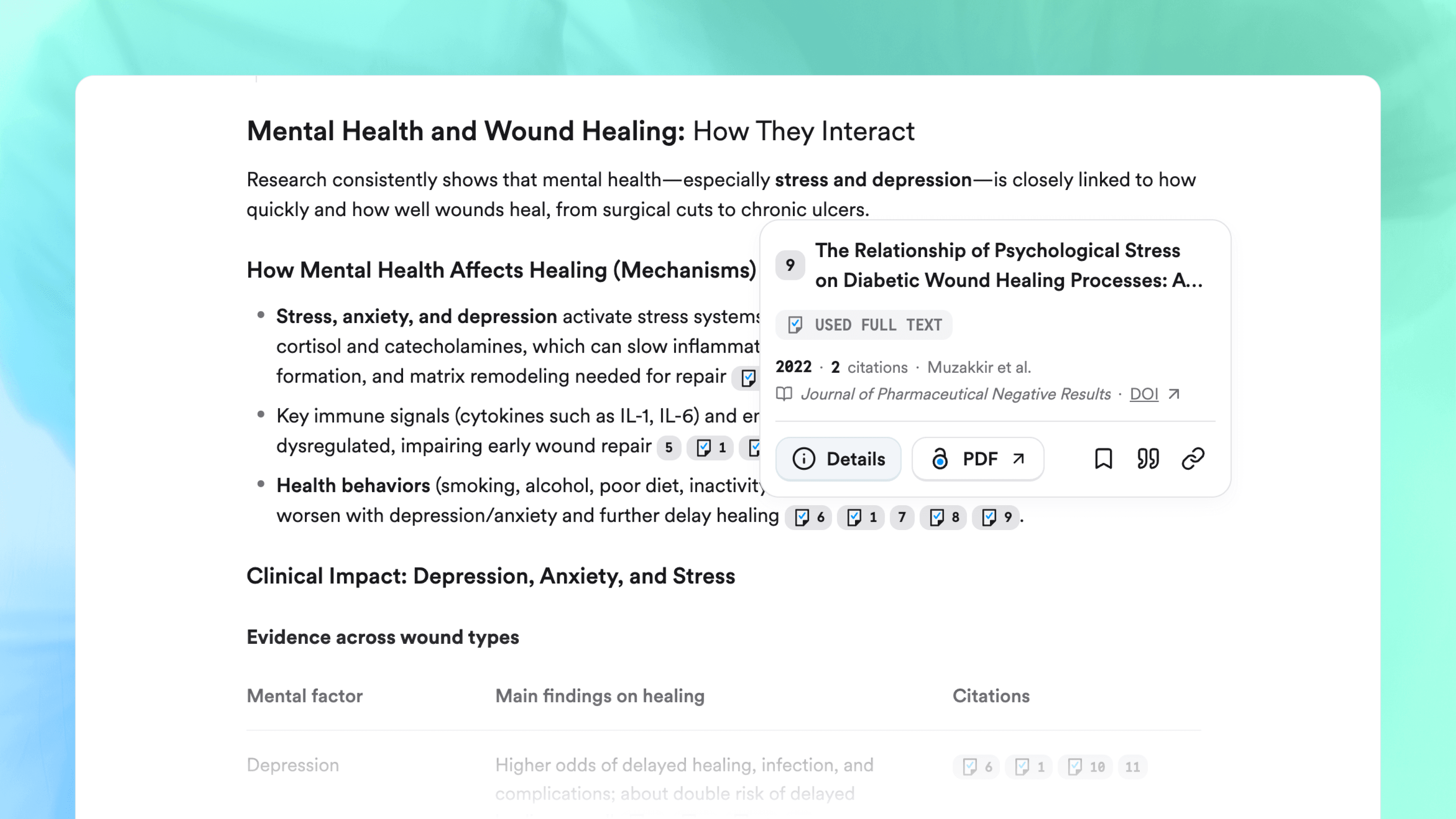
When she hits a specific challenge mid-writing, she turns to Consensus to work through it. If she knows a concept is well supported in the literature but needs to find the right citation to back it up, she uses Consensus to locate the most relevant reference. When she discovered there were no articles specifically applying a psychoanalytic approach to patients with wounds, she asked Consensus how to address that gap in the literature. For a researcher writing in English as a second language, it also helps her work through phrasing and academic writing in ways that feel natural rather than mechanical.
Beatriz is aware of the conversation happening in academia around AI and research tools. For her, the question was never whether to use them, but how. She points out that students are already using ChatGPT and other AI tools regardless of whether their institutions approve, and that the real issue is not the technology itself. The problem is that somewhere along the way children have lost sight of why it is important to learn at all. When she sat down to write the introduction to her thesis, she used Consensus to find and organize the literature, but the thinking, the argument, and the reading were entirely her own.

The Evidence to Back It Up
Beatriz's thesis asks what a wound means to the person living with it. It's a question that medicine has always struggled to ask: not how do we fix this, but what is it like to carry it? She learned that distinction long before she ever set foot in a research lab. Now she is building the science to back it up: a thesis, a specialization, a PhD, and eventually, she hopes, public health policies that put psychologists where patients need them.
Share Your Story
Tell us how Consensus accelerates your impact. Email [email protected] or tag us on social media. Let’s keep moving knowledge and healthcare forward.