From Concern to Rigor: How Université Laval Turned an AI-Related Challenge into an Opportunity
Catherine Lamy, a librarian at Université Laval in Canada, sits down with us to discuss the rapid adoption of Consensus on Campus.

With the arrival of generative AI on university campuses, higher education institutions have had to navigate a new set of challenges. At Université Laval in Canada, students quickly embraced conversational AI tools, prompting the institution to response just as rapidly by providing guidance and support to its community on the responsible use of these technologies.
At the Library, staff began to observe some concrete consequences of this growing adoption. "We had a lot of cases of just people showing up with a bunch of sources and being like, 'I can't find these sources...'" University Teaching and Learning Librarian Catherine Lamy recalls. "And it would be like, 'Oh, ChatGPT gave them to me'."
The use of AI tools has further reinforced the importance of promoting critical thinking and source evaluation among users, issues that are central to the Library's mission. This situation highlighted the need to strengthen information literacy skills and ensure that members of the university community are equipped to assess the reliability and validity of the information they encounter and use.
Research in any language
Rather than resisting this shift, Université Laval Library chose to embrace it. In collaboration with the Teaching and Learning Support Service, library staff developed support resources, including. web pages and guides, and organized training sessions for both students and faculty members.
To address the root of the problem, the University introduced AI tools specifically designed for rigorous academic research, including Consensus. The impact on accessibility was quickly apparent. The ability to interact with the tool using natural language and then engage directly with the scholarly documents it identified immediately appealed to students, for whom traditional search methods based on keywords and Boolean operators often posed a challenge.
The built-in translation features also helped make research more accessible. Students could conduct searches in French or in their native language and receive instant, evidence-based answers in that same language. This significantly reduced language barriers and made scholarly research easier to approach for a broader range of users.
"It really kind of rang this bell of how accessible it could make research," Catherine says.
A starting point, not an answer
Crucially, Consensus does not reward shortcuts. By keeping references at the forefront and offering visualizations like the Consensus Meter, it encourages students to interrogate sources and view research as a conversation rather than trust an AI's verdict. Librarians teach Consensus as a complement to traditional databases, helping students build their own research libraries.
"We tell them: 'Yes, Consensus gives you an answer... But it comes only from 20 or 50 papers... You need to keep looking. You need to keep reading, it’s a starting point'" Catherine explains.
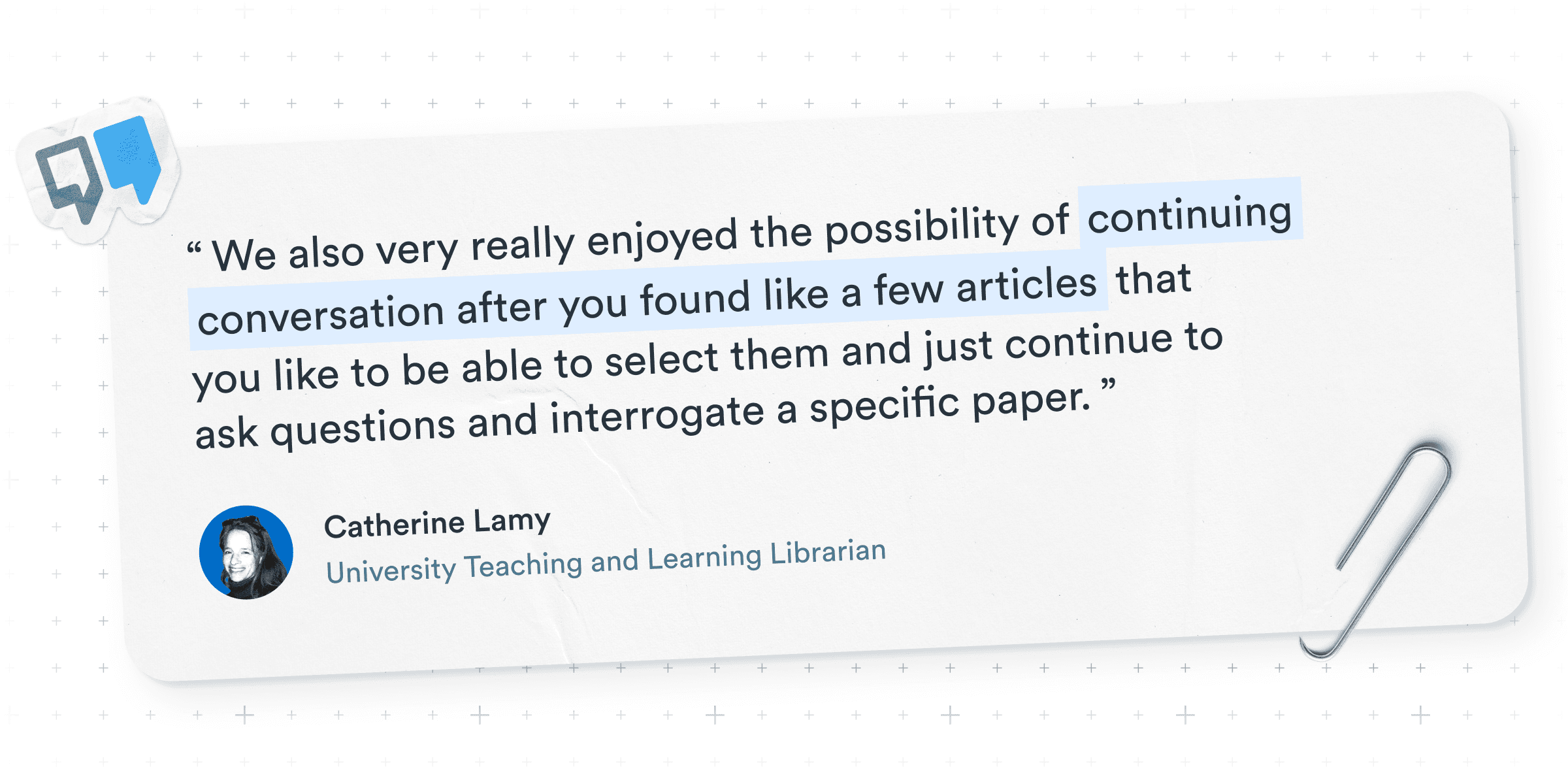
That process of continued digging and interrogation is built into the workflow. Students can select the papers that matter, keep the conversation going, and interrogate a specific study directly – a feature Catherine notes as one of the library’s favorites.
Campus-wide impact
Laval’s proactive strategy has sparked staggering organic adoption. A year ago, roughly 20 active users were experimenting with Consensus on campus. Today, the numbers are:
Over 2,000 active users on campus.
Over 50,000 searches conducted.
Nearly 100,000 direct paper clicks
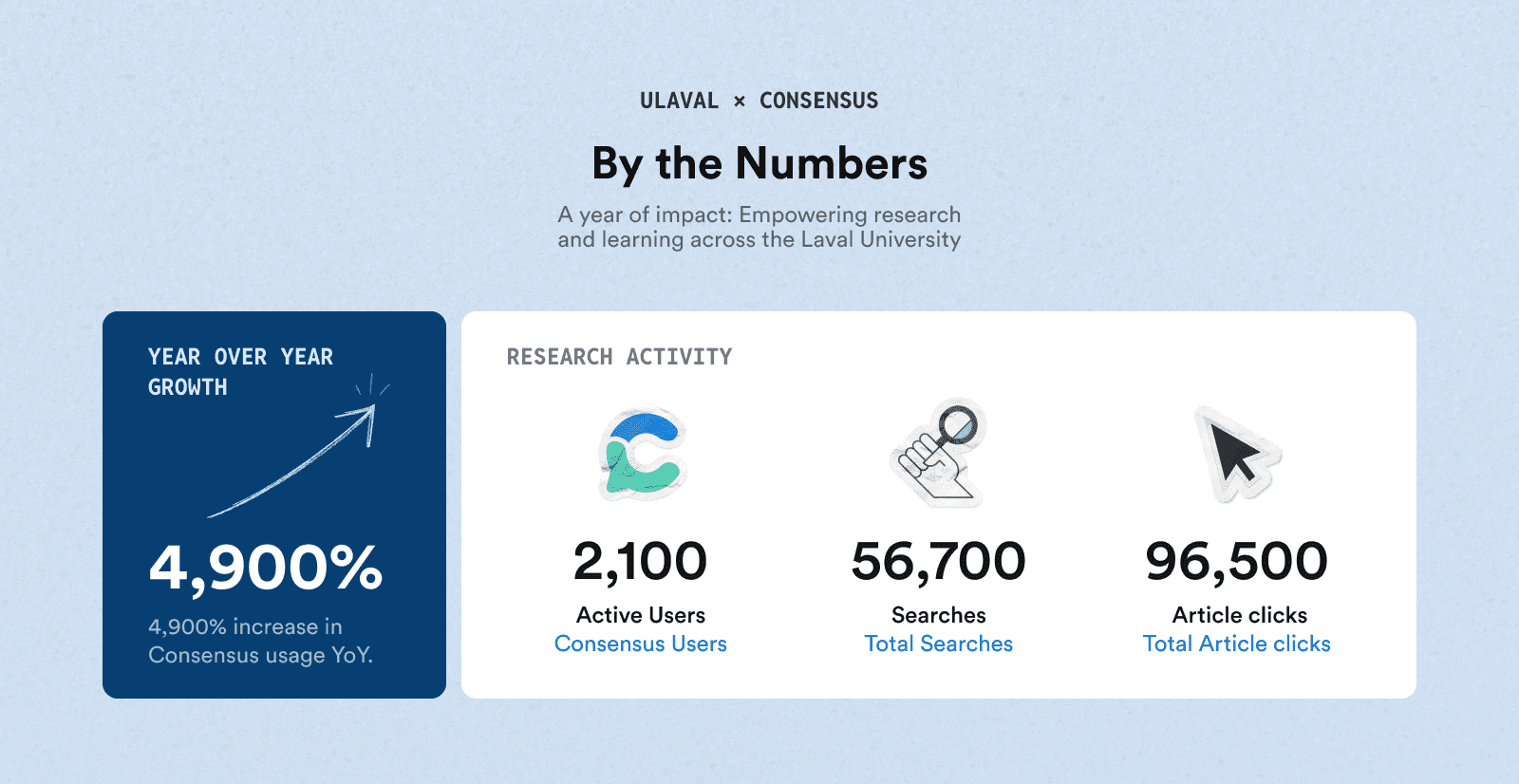
That last figure is significant: students aren’t stopping at the summary, they are actively diving into the original research.
By leaning into AI responsibly, Laval's library has shown that the technology can actively strengthen scholarship and critical thinking. As Catherine reflects: "If you don't do the research, if you don't read, if you don't fact check, you will never bring your critical thinking and your own way of thinking".