
Using Consensus to Unlock Interdisciplinary Research
Dr. Barbara Han, Disease Ecologist, Cary Institute of Ecosystem Studies
Before the Spillover
Most infectious diseases that devastate human populations don't start in humans. They start somewhere else, quietly, in an animal that may never show symptoms. That gap, between where a pathogen lives and when we find out about it, is where outbreaks happen.
Dr. Barbara Han has spent more than a decade trying to close that gap. As a disease ecologist at Cary Institute of Ecosystem Studies in upstate New York, she builds predictive models that ask: which pathogens, living in which animals, are most likely to spill over into human populations? Her lab's models run across the messy tangle of variables that govern disease emergence: animal physiology, viral molecular structure, soil chemistry, geographic range, human contact patterns.
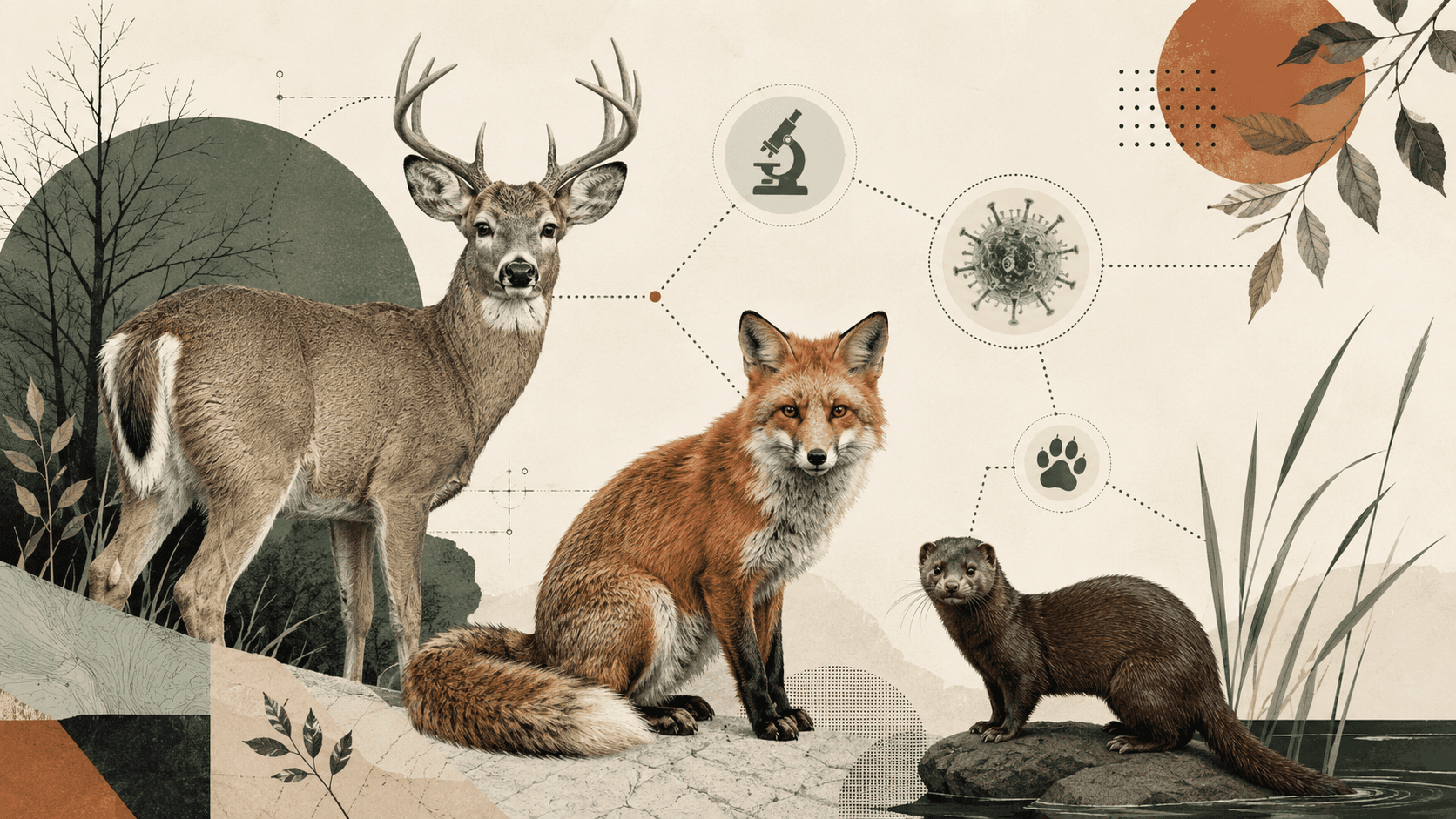
When SARS-CoV-2 began spreading in early 2020, her lab produced a model predicting which mammal species could become new hosts for the virus. The model named white-tailed deer, red fox, and mink, and independent surveillance later confirmed all three. For outbreak researchers, that kind of prediction can turn an overwhelming search across thousands of species into a focused surveillance strategy, helping scientists understand where a virus may persist, evolve, and potentially spill back into people.
That kind of predictive work sounds like it should be straightforward. Identify the pathogen. Identify the animal hosts. Build the model. But the reality of what Barbara's lab does is something closer to archaeology crossed with translation work. They are constantly excavating knowledge from fields they were never trained in, using terminology they didn't grow up with, building bridges between disciplines that have never spoken to each other.
The Fields That Don't Talk
Take filoviruses, the family that includes Ebola and Sudan virus. Barbara's lab has been developing a model to predict which of 11 filovirus species can infect which of roughly 1,300 bat species. The combinatorics alone are vast. But the harder problem is epistemological.
To build that model well, her team needs ecology, evolutionary biology, and the molecular virology of how a virus interacts with a cell receptor. That last domain has its own vocabulary, its own conceptual frameworks, largely disconnected from the field biology that defines most of her work.
The same dynamic plays out across every project in her lab. Highly pathogenic avian influenza spreads through water, which means understanding it requires getting into hydrology and soil physics. Leptospirosis, growing in New York City, leads quickly into questions about biofilm formation in urban soils. "The bat has to shed the virus, and the virus goes into the soil," Barbara says. "Now you're in a different realm. You're talking about physical chemical properties of soil. You're in geology and karst and calcium and things that are not at all connected to Ebola. At all."
The problem is not just that these bodies of literature are large. It's that each one has its own jargon, and the jargon rarely translates. "There's semantic terminology where you're using different words to mean the same thing, and sometimes different words to mean different things," she says.
Before finding Consensus, this process meant long sessions in Google Scholar, crossing her eyes over page after page of results. "Getting your hands around a big new body of literature that you want to try to parse and wrangle and bring into your world," she says. "It can be exhausting."
Peeling the Onion
Barbara found Consensus early, when she was exploring AI-assisted research tools. She came for the speed and stayed for something more specific: it understood questions she didn't yet know how to ask precisely.
Her typical workflow is what she calls peeling the onion. She starts with the most specific version of her question, knowing it probably won't return results. "The best possible thing would be that somebody has already researched this and I can just draw on their work. But that almost never happens." When results are sparse, she broadens by one layer: instead of asking how Ebola interacts with soil, she asks how viruses persist in soil. That surfaces papers. She reads enough to adjust her vocabulary, then narrows again: zoonotic viruses, specifically bat-borne. Each layer teaches her something about how the literature is organized, which terms matter, where the actual edges of the field are.
Part of what makes this work for her is that Consensus handles plain-language questions without requiring her to already know the right keywords. "I can type how I would normally ask that question, and it kind of understands what I want." And when results are sparse, that information is valuable too. "Sometimes it'll come up short and I think: okay, I've got a good idea here. Nobody has looked at this."
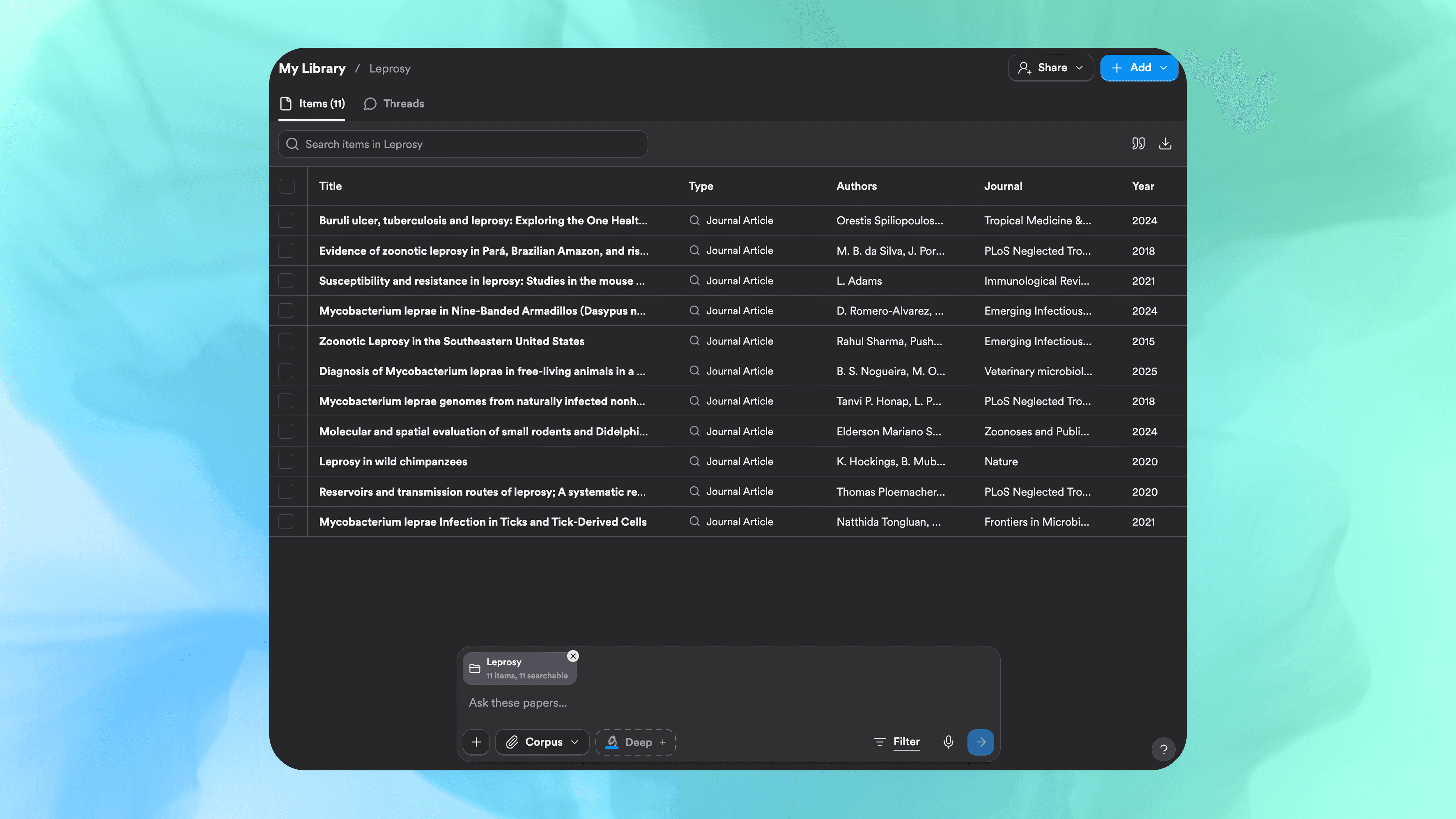
She keeps folders in Consensus for each active research thread, sometimes fifteen at a time, picking them back up like bookmarks in an ongoing research conversation. When a result doesn't convince her, she traces it back to the source.
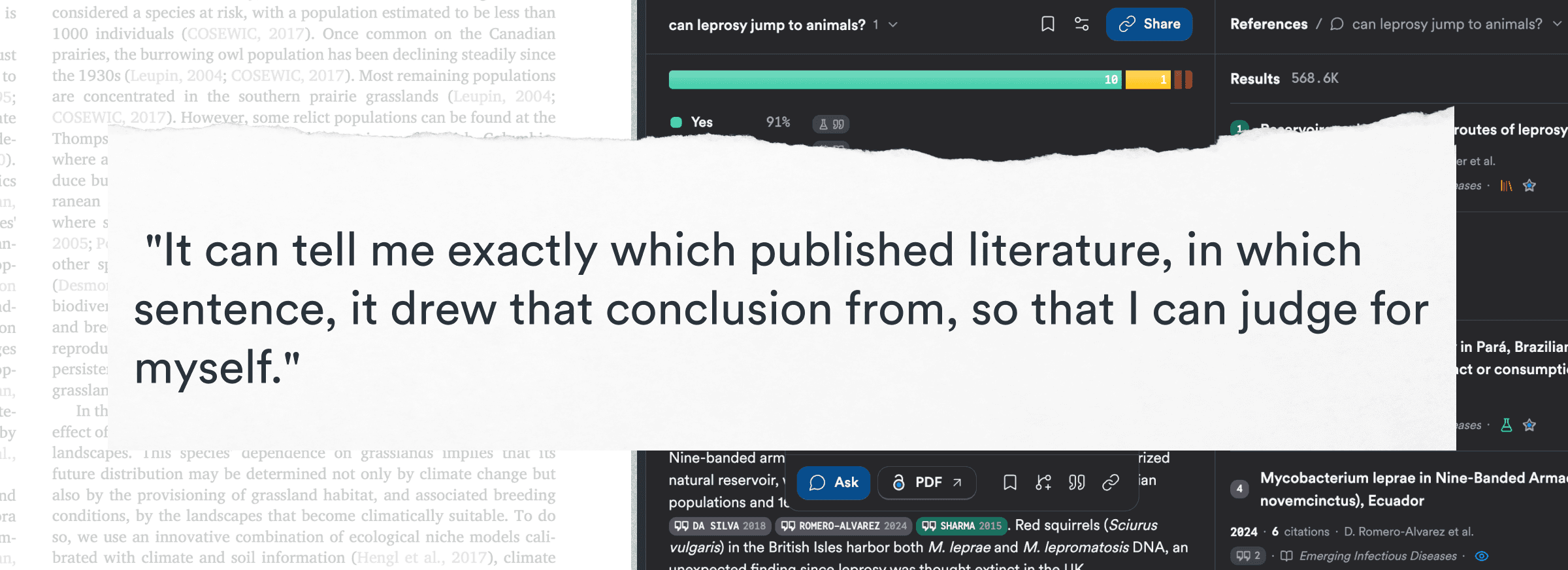
That traceability matters to her, especially as AI tools multiply and skepticism in scientific circles is appropriate. "Where there's a little bit more skepticism is in the information it gives you after it's been interpreted. If the interpretation is incorrect, you don't have a way of checking the incorrectness of it." Consensus, she says, keeps her in the driver's seat. The papers are real, published, citable. She still does the judging.
Where Human Creativity Leads
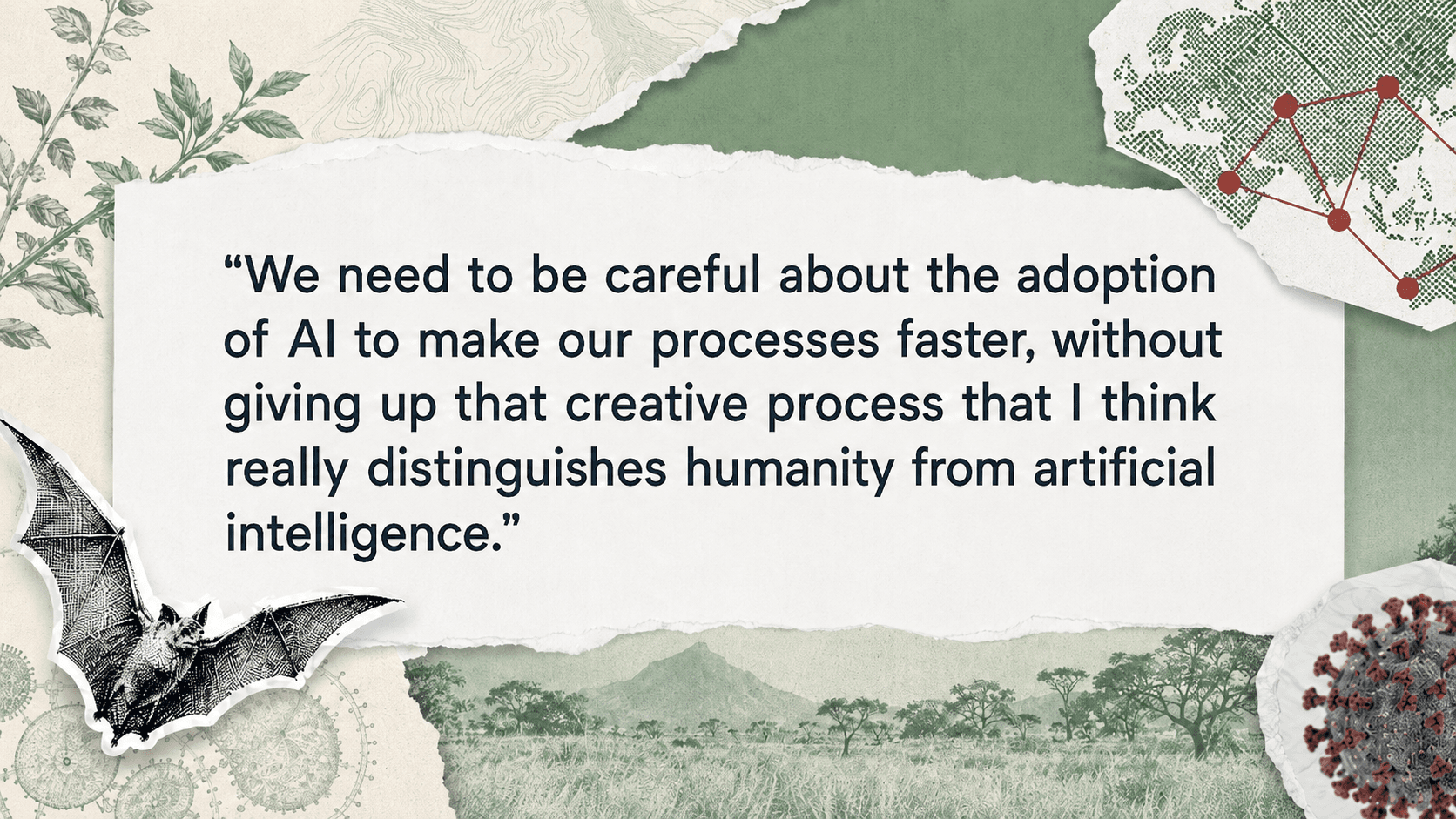
Barbara is careful about what AI can and can't contribute to science. Speed, yes. Organization, yes. Getting from zero to functional literacy in an unfamiliar domain, yes. But the creative leap that makes science actually advance? She's skeptical that any tool is close to replicating it.
"Being able to apply a concept that is observed and made firm in some other domain and thinking: I understand the concept here, and I think it could apply to this totally different problem in a totally different part of the world, in a different discipline." That cross-domain generativity, she argues, is born from deep creativity, and it doesn't emerge from pattern-matching alone.
She talks about the famous moments in science when breakthroughs arrived sideways, from seeing something ordinary and recognizing its implications for a completely different problem. That kind of thinking, she believes, is what humans bring to science that no tool yet replaces.
She remembers the moment that started her on this path. She was six or seven years old, walking along a stream, when she saw a frog floating belly-up. There were no visible wounds. She couldn't stop thinking about what had killed it. That question stayed with her through a career in ecology, a dissertation on amphibian disease, and now more than a decade of work trying to predict the next zoonotic spillover before it becomes a crisis.
"I'm so curious about the world," she says. "There are endless questions to ask about infectious disease."
The tools keep changing. The questions that drive her don't.