Quietly getting Ready: How UVA’s Librarians Beat the AI Rush

Jenn Huck, a libarian at the University of Virginia, shares her unique story of adopting Consensus at a massive, decentralized public institution

UVA is a large university with a strong decentralized structure. Like many institutions of its size, the schools operate with a good deal of independence, setting their own curricula and in many cases their own policies, including on AI. This decentralization can be an asset, giving individual schools the ability to experiment and adapt quickly, but it can also make coordinating something like an AI strategy more challenging.
"UVA is just an extremely decentralized place... there's not any one group or unit that would be coordinating efforts around AI," says Jenn Huck, Associate Director of Research Data Services and Liaison to the School of Data Science.
Without an overarching institutional directive, generative AI adoption on campus started slow and organic. They first felt the AI wave trickle in when students began showing up at library chat helpdesks with entirely "hallucinated citations" generated by standard commercial chatbots, trying to locate academic sources that didn't exist.
But underneath the institutional quiet, the librarians were already working. A library-wide AI interest group had formed to “get the reps in” and build real confidence with the tools, testing what held up, what didn't, and what they'd be comfortable putting in front of students.
The Delicate Balance
They needed a platform that met students' rapidly changing expectations in an AI-driven world without asking librarians to compromise on what they could ethically support. They needed a tool that bypassed the frustrating search barriers traditional databases pose to novice researchers, but did so without taking shortcuts on actual learning
"All of the tools that came before really did rely on being able to have that precise language," Jenn explains, referring to the heavy jargon and keyword barriers that often leave undergraduates and early graduate students stuck. "Librarians like to search, nobody else does — they want to just get to the resources, and who can blame them? So, I think that Consensus just gets people there faster".
Consensus seemed to fit that gap well. It was fast and intuitive enough to meet students where they actually are, but it only summarizes real, peer-reviewed papers it has actually retrieved. It doesn't generate an answer and then hunt for support, so there's nothing to fabricate. That meant the underlying work of reading and evaluating the research still had to happen.
"We do think Consensus is a strong product for discovery. So, we do come into the classroom and say, 'why don't you try this? Please take a look at this'. And it is very well-received by the students" Jenn says.
So when Library Dean Leo Lo arrived with his AI Literacy Framework, the librarians already had practical experience to draw on and a growing sense of which tools seemed worth recommending to their respective departments. With that groundwork in place, the roll-out at UVA followed not long after.
The Results
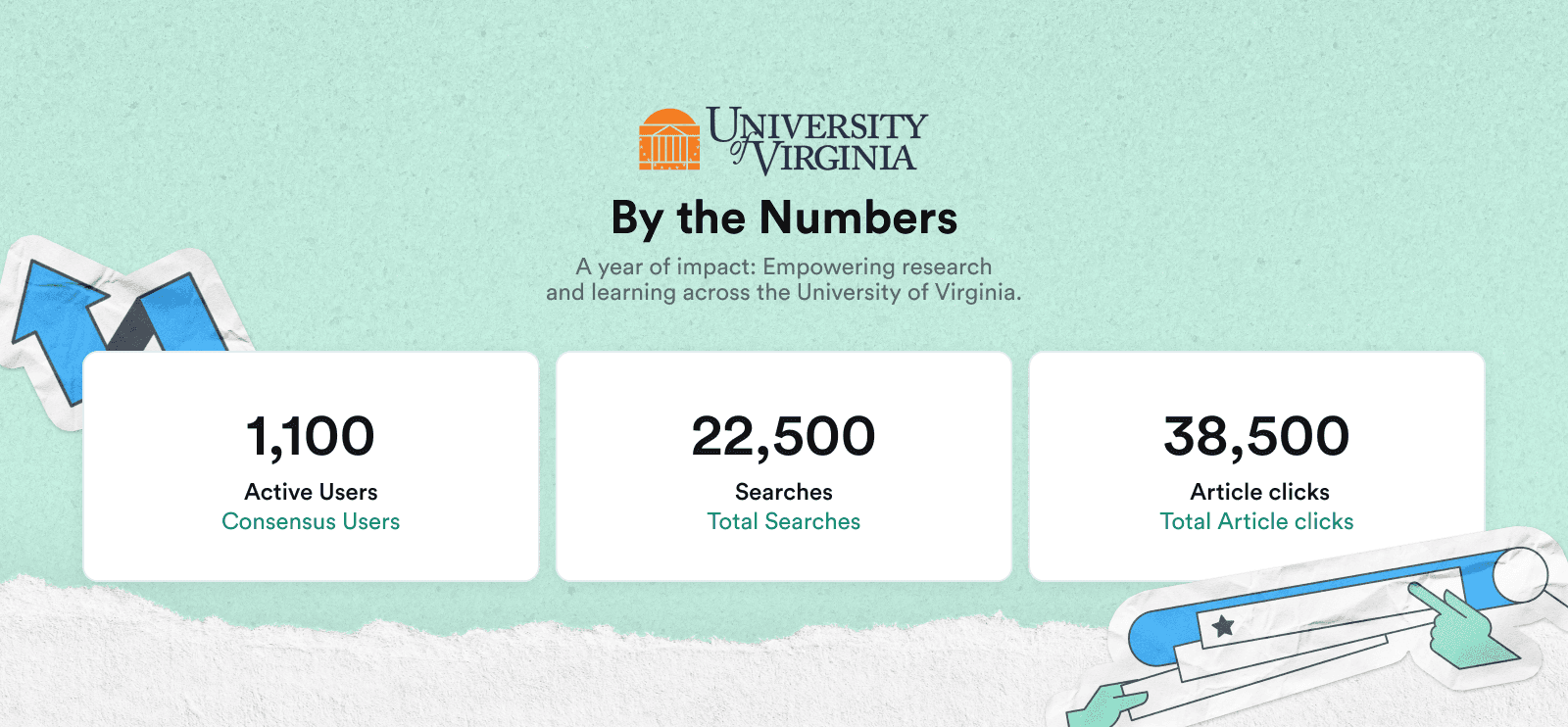
The success of this rollout was powered by the library's relentless outreach — public research guides, library blog posts, hands-on workshops — with no mandate behind it. In a single year, usage went from roughly 30 active users to over 1,000, with tens of thousands of searches conducted.
It was not a top-down rollout, it was a group of librarians who took the time to figure out what was worth recommending, and then recommended it.
As Jenn puts it: "It's not like Consensus is writing the literature review for you," Jenn explains. "So, I appreciate that about the product... use it more for search and discovery and then, read the dang articles, right? Still do that."