
The Secret Social Lives of American Crows

Dr. Anne B. Clark, Behavioral Ecologist and Professor Emerita, Binghamton University
The Social Network You Cannot See
An American crow may spend the morning with its family, fly miles to feed alongside neighboring groups, and end the day in a winter roost containing thousands of birds. It may encounter relatives, rivals, migrants, and longtime companions along the way. Researchers can follow some of those movements, but they still cannot see the full network connecting them.
Clark, a behavioral ecologist, evolutionary biologist, and professor emerita at Binghamton University, has spent nearly three decades trying to understand that hidden social world. Using wing tags, radio trackers, nest watches, census routes, and strategically scattered peanuts, she and her collaborators have followed generations of crows across upstate New York.
The closer they have looked, the more complicated the picture has become. Crows grow up in extended families, travel between social groups, recognize individual voices, and gather in enormous communal roosts. They may disappear for months and return to the same territory, sometimes alongside family members whose movements remain impossible to fully trace.
Still, she has spent decades trying.
A Family Inside a Larger Network
American crows grow up in families that may include a breeding pair and several older offspring. Males often remain with their parents for years, helping feed and protect younger siblings before breeding themselves. In Clark's study population, males frequently did not begin breeding until they were four or five years old, while females tended to leave and begin breeding earlier.
But the family is only one part of a much larger social landscape. Crows leave their territories to forage alongside neighboring groups, encounter unfamiliar birds at shared food sources, and gather with local and migrating crows in communal roosts.
Clark compares the challenge of understanding these relationships to watching people move between houses, hotels, and shopping centers without knowing why they are there. Are they meeting relatives and friends, or did they simply arrive because the sneakers were on sale?
Even when researchers know that birds appeared in the same place, they cannot always tell what brought them together. Clark remembers one family that disappeared from upstate New York and was later reported in Virginia. Its members returned the following spring within days of one another, suggesting they had migrated south. But the researchers could not determine whether they traveled together.
When the Crows Know You Back
Following the same birds year after year meant that the crows gradually learned the researchers' habits. When the team slowed down inside a familiar territory and threw peanuts onto the ground, birds often emerged from the trees.
One crow learned to recognize the Subaru driven by Clark's longtime collaborator Kevin McGowan. It followed him onto the property at the Cornell Lab of Ornithology, landed nearby, and waited near his usual parking spot for food.
The researchers learned the crows' routines in return, recognizing individuals through their wing tags, movements, partners, offspring, nesting histories, and behavior.
That familiarity made the birds' deaths difficult. During the 2003 West Nile virus outbreak, the team lost crows they had followed for years. Clark also remembers a female called MP who survived into her nineteenth spring and was still breeding before she disappeared.
"You banded her, and she's six years old," Clark says of another female the researchers lost. "She's got babies. You had big hopes for her and her babies. She knows you and comes to you for peanuts. Of course we get attached."
Long-term field research produces datasets, but each entry comes from an individual life.
What Crows See That We Cannot
To an untrained human observer, one American crow may look nearly identical to another. Crows, however, experience a broader visual world. Birds can perceive ultraviolet wavelengths and process color through four channels, compared with the three humans use.
In a study co-authored by Clark and Texas A&M behavioral ecologist Jessica Yorzinski, the researchers measured how crow feathers reflected visible and ultraviolet light, then modeled those colors through a bird's visual system. They found no clear plumage signal separating males from females, but they did detect differences associated with age.
"We could pick up an age signal," Clark says, suggesting that crows may be able to estimate another bird's age by looking at its feathers. Whether they actively use that information when making social decisions remains an open question.
Some age differences can also be seen by experienced human observers. First-year crows carry lower-quality wing and tail feathers grown while they were developing rapidly in the nest. By summer, those feathers may have faded to rusty brown, while newer body feathers remain black. Other distinctions may be much more apparent to a bird capable of seeing ultraviolet light.
Crows can also identify one another by voice. Every type of call Clark and her collaborators have examined contains individual variation. A crow may recognize who is speaking across many vocalizations, much as a person recognizes a familiar voice regardless of what is being said.
Learning to See Crows as Crows
Clark is careful about anthropomorphism, the tendency to interpret animal behavior through human emotions and social customs.
Consider the popular belief that crows bring shiny gifts to people who feed them. Clark remains skeptical.
Young crows do pick up and manipulate objects such as bark, leaves, and sticks. Clark's students found that juveniles were especially likely to carry or examine nonfood items, while adults largely ignored them. An object left near a feeding spot may reflect exploration rather than an intentional offering.
That does not mean the relationship is imaginary. A crow may recognize the person who leaves food, remember the routine, and change its behavior accordingly. What cannot be assumed is that the crow understands the exchange as friendship, gratitude, or gift-giving.
"People want to be connected," Clark says. "You put peanuts out there and you want to know that crow knows you do that. And so do I."
Why Crows Move Into Cities
American crows prefer landscapes that combine open ground for foraging with tall trees for nesting. Cities and suburbs often provide both, along with another important advantage: relative safety from hunting. Crows learn where people pose a threat and where they can live closer to them.
"They know when they're going to get shot at," Clark says. "That's one of the big changes in their behavior as they move into cities."
Yet urban environments can also be deceptive. A manicured lawn or golf course may resemble ideal crow habitat while providing relatively few worms, beetles, snails, and other mineral-rich foods. Clark describes these environments as potential ecological traps: places that appear suitable but lack something an animal needs to thrive.
In her research, nestlings raised in urban areas were often smaller than rural birds, while chicks raised around golf courses had lower levels of circulating calcium. Helping crows, Clark says, can be as simple as using fewer pesticides, protecting mature trees, supporting healthy soil and insect life, and maintaining connected areas of habitat.
Feeding them occasionally is not necessarily harmful, but it cannot replace a functioning ecosystem.
"Peanuts are fine," Clark says. "But they can't live on peanuts."
Finding the Literature Behind the Behavior
As Clark analyzes decades of crow data, she must also trace the scientific literature behind the behaviors she and her colleagues observed. That can be unusually difficult in animal behavior, where important evidence is scattered across books, dissertations, government reports, monographs, and studies published long before research became easily searchable online.
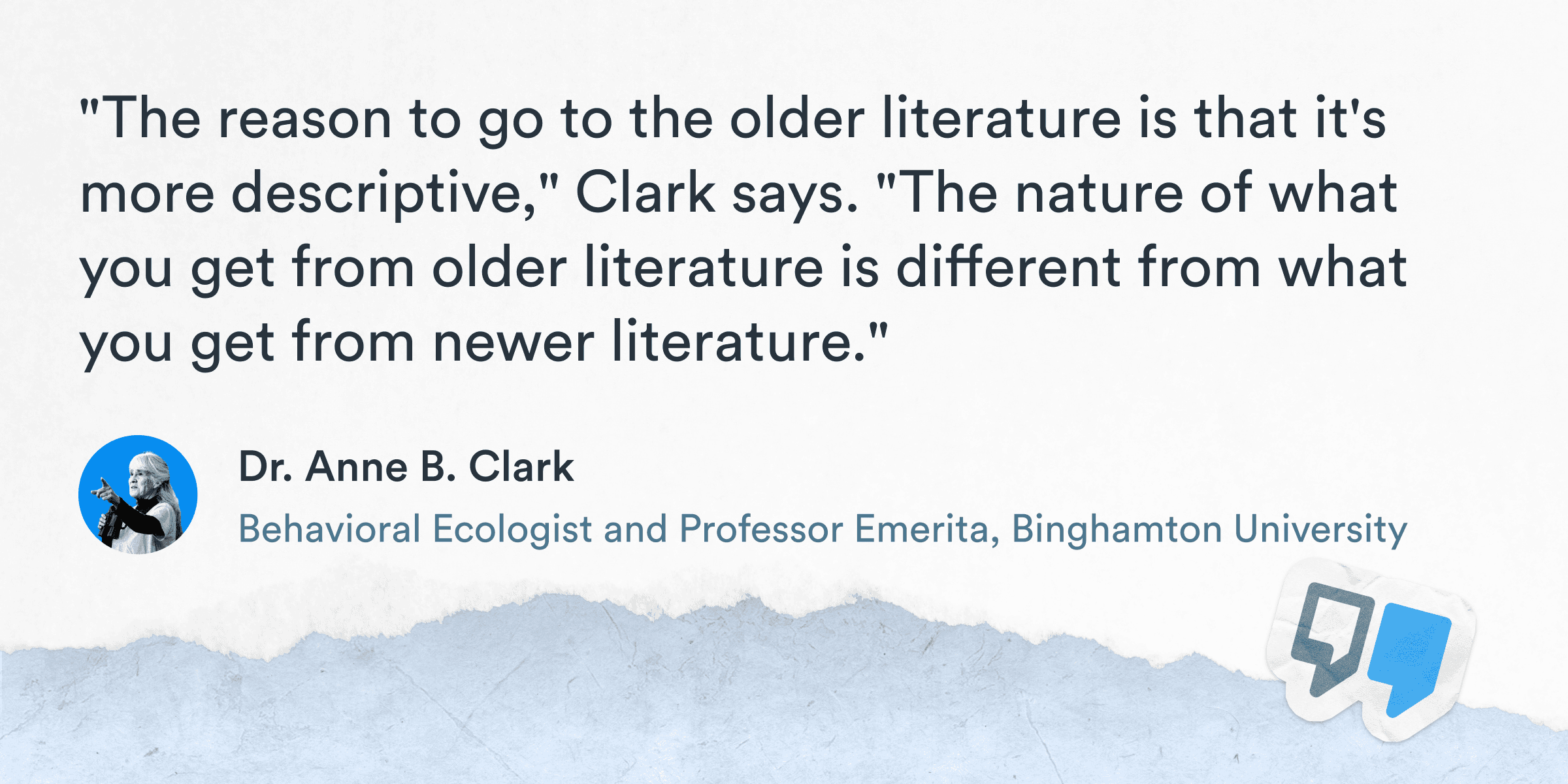
This matters when researchers create ethograms: structured lists that define an animal's behaviors and identify where each one has been documented. A recent paper may report whether an experiment produced a statistically significant result. An older source may contain the detailed description of how a bird called, approached a rival, manipulated food, or defended a nest.
Clark uses Consensus to locate relevant research and begin mapping literature that spans generations. The tool helps her reach scientific papers more quickly, but her expertise remains essential for deciding which sources matter, recognizing what may be missing, and determining whether a response actually matches the structure she requested.
As a member of the Consensus Faculty Advisory Board, Clark also shares feedback with our product and engineering teams. Her work has highlighted the need to improve access to older monographs and government reports, retrieve literature across broader time periods, and produce outputs that reflect the established frameworks researchers use within their disciplines.
For Clark, Consensus does not replace expertise. It can reduce the time spent searching so that researchers can devote more of their attention to interpreting the evidence.
Still Watching
Clark is officially retired, though not in any ordinary sense. She continues to analyze decades of crow data, write papers, and work from a room at Binghamton that she calls "the den of antiquity."
Nearly thirty years of observation have revealed how crows grow up in extended families, recognize individual voices and people, maintain relationships across distance, and adapt their behavior to human environments. But the closer Clark has looked, the larger their social world has become.
She still cannot say how many other crows one bird knows, whether families remain together throughout migration, or how relationships persist inside winter roosts containing thousands of birds. A crow crossing overhead may be moving between relatives, neighbors, rivals, and longtime companions whose connections remain invisible to us.
"Most people in the U.S. can just go outside and watch crows," Clark says.
The crows, meanwhile, may already know exactly who is watching.
Dr. Anne B. Clark is a professor emerita at Binghamton University and a member of the Consensus Faculty Advisory Board. Her comparative evaluation of AI research tools is in preparation for publication.