
A Librarian’s Guide to Consensus
A Librarian’s Guide to Consensus
The Playbook for Supporting Students and Faculty with Evidence-Based Research

Jonathan M. Torres, MLIS, MA
Associate Professor, Business and Data Services Librarian

01
Introduction
The emergence of Gen-AI continues to change the landscape for librarians and information professionals. I have created a Librarian’s guide to serve as a playbook, showing how Consensus can assist patrons in organizing content and finding the best information to support their research from beginning to end. Here is a step-by-step guide.
02
Teaching Effective Prompting Fundamentals to Faculty, Researchers, and all Patrons
Understanding the difference between prompting general-purpose AI tools and research-specific systems is essential for helping patrons become effective researchers.
Approach to Prompt Structure
Traditional verse Research Gen AI Platforms
Unlike general LLMs that generate text from their training data, Consensus retrieves and synthesizes actual published research. You can ask conversationally (“Show me recent evidence on X”) or precisely (“RCTs from 2020–2024 on Y”). Consensus interprets open-ended requests and automatically constructs rigorous searches behind the scenes, filtering by study type, date, and relevance without requiring Boolean operators or database expertise.
Consensus, by contrast, works best when the prompt is precise and research-driven, as if you are querying a database. With Consensus, you are directing the tool to find and summarize existing research using prompts such as “What do peer-reviewed studies say about X?” or “Compare the evidence for approach A versus B.” Consensus surfaces actual findings with citations, helping you quickly identify which papers deserve deeper attention.
Limitations
LLMs like ChatGPT and Claude work best with open-ended, conversational prompts. You can request tone, style, or creative outputs. These systems are excellent for brainstorming and writing support, but are prone to hallucinations.
Consensus does not hallucinate in this way because it pulls from published literature, but it is limited to the research it indexes. Librarians can highlight this tradeoff and show when each tool is most appropriate.

When a student asks, “How does social media affect mental health?” I explain that ChatGPT might return a conversational overview or opinions. Consensus, on the other hand, can pull together the main findings from peer-reviewed studies, complete with citations and statistics. This not only gives them reliable evidence but also teaches them how to formulate stronger, research-oriented prompts.
This example helps students understand how and why their prompt must shift depending on the tool:
ChatGPT/Claude → “Explain this,” “Help me think through this,” or “Write this for me.”
Consensus → “What does the research show?” “Compare findings,” or “Summarize the evidence on X.”
Through this contrast, students learn the fundamental difference between creating text with an LLM and retrieving and synthesizing real studies with Consensus.
03
Interpreting the Evidence Landscape with the Consensus Meter
Once patrons understand how to form a research-ready question, the next instructional step is helping them interpret the initial evidence overview using the Consensus Meter.
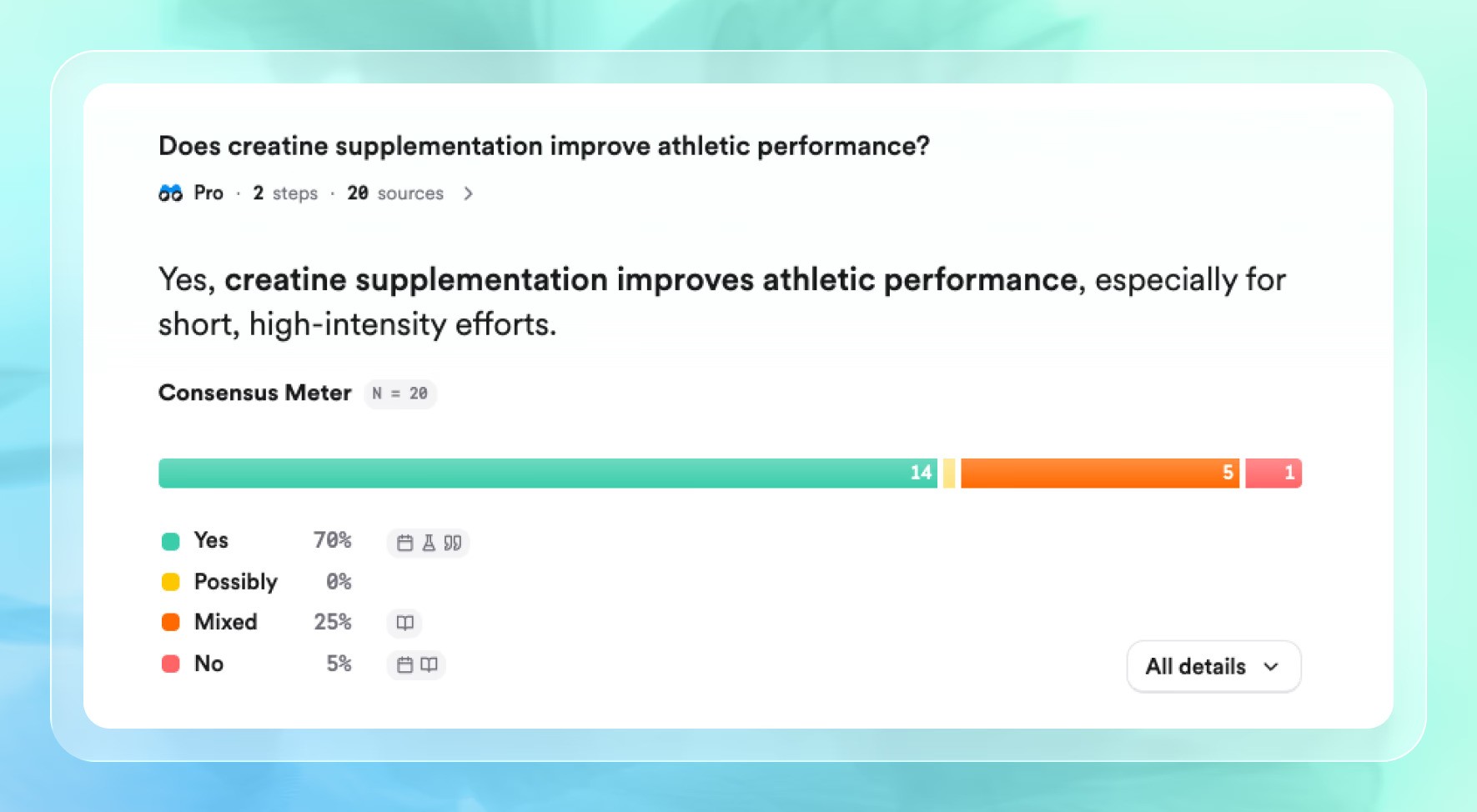
The Consensus Meter is one of the most librarian-friendly features because it instantly shows where the science stands. By aggregating the most relevant studies into a visual snapshot, it helps students quickly understand whether the literature generally supports, contradicts, or shows mixed findings on a topic. The Meter is triggered whenever a user asks a yes or no research question, such as questions that begin with "Does," "Is," or "Can," where the goal is to determine whether an effect exists.
If a student comes to the reference desk asking, “Does creatine supplementation improve athletic performance?” the Consensus Meter provides a quick evidence overview.
From there, I encourage them to dig deeper by applying filters such as:
Meta-analyses (to prioritize higher-quality evidence)
Recent studies (to ensure currency)
Journal ranking (to introduce evaluation of source quality)

04
Applying Filters and the “Less Is More” Principle
After students understand how to interpret the initial evidence snapshot through the Consensus Meter, the next step is teaching them how to refine a search. One of the most important skills in reference and instruction work is helping patrons recognize that narrowing a topic leads to stronger, more usable research results. In this context, “less is more” becomes a foundational research strategy.
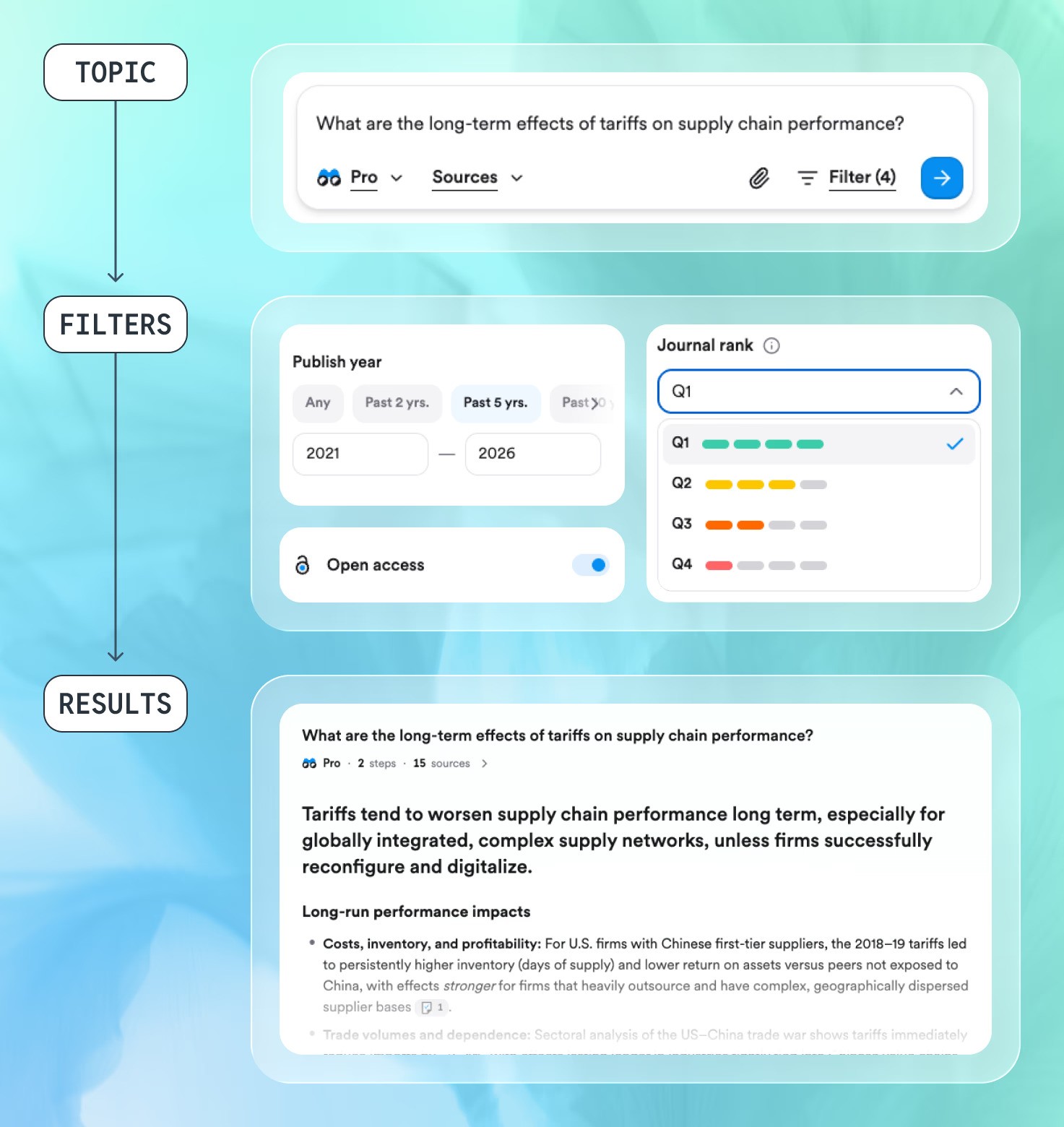
Consensus supports this process by allowing patrons to filter results by discipline, publication year, journal ranking, study type, and open access. These filters help students move from broad curiosity to precise, academically rigorous inquiry.
Initial Topic
What are the long-term effects of tariffs on supply chain performance?
Search Filters Applied
Past 5 years
Journal Rank: Q1
Open access
Result
The narrowed search yields results more focused and actionable. In this example, the refined search highlights specific impacts such as increased costs, reduced efficiency, and disruption of global value chains, citing papers from 2024 and 2020
This demonstrates to students how a narrower query, paired with thoughtful filtering, leads to clearer and more academically meaningful evidence.
05
Understanding Methods Through Search Strategy Visualizations
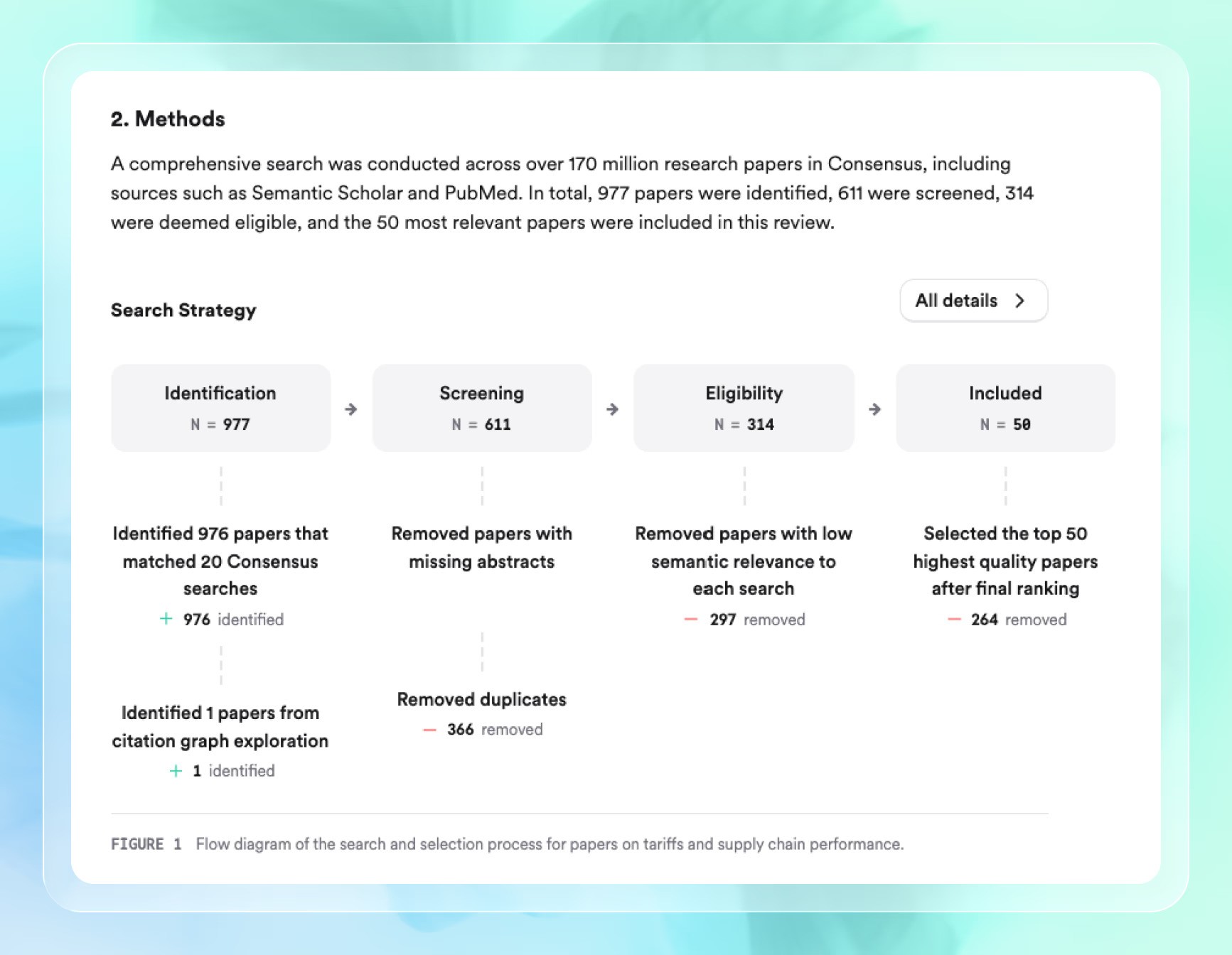
As students become more advanced researchers, it is helpful for them to see how a search is structured and refined behind the scenes. Consensus provides a visual breakdown of its search process, which mirrors the logic of systematic review methodology. This visualization helps patrons understand not only what studies were retrieved, but why certain studies were included or excluded.
Consensus retrieves studies from trusted scholarly sources such as Semantic Scholar and PubMed, providing transparency into both the search process and the origin of the evidence being analyzed.
This feature is especially valuable when teaching graduate students, faculty, or anyone working on literature reviews, because it introduces them to the core components of rigorous evidence synthesis in a clear and approachable way.
Librarian's Role
Demonstrate how Consensus visualizes the search strategy, which is critical for systematic reviews.
What the visualization shows
Consensus presents a simplified, PRISMA-like flow of the information retrieval process:
Identification: collects relevant papers identified across sources such as Semantic Scholar and PubMed.
Screening: Removes duplicates and articles with missing abstracts
Eligibility: Evaluates remaining studies for semantic relevance and quality
Included: Final selection of the highest-quality, most relevant papers
This structure makes the research process more transparent and familiar, particularly for students learning systematic review principles. It provides a practical, visual introduction to how evidence is gathered and refined.
06
Teaching Advanced Literature Review Skills to PhD-level students and faculty using Deep Research
For graduate students, faculty, and researchers conducting in-depth literature reviews, Consensus offers a Deep Research feature that provides a structured, multi-step exploration of a topic. This tool goes beyond a standard search by guiding users through a series of focused questions that reveal the breadth, nuance, and complexity of the research landscape.
Deep Research is especially helpful when patrons are unfamiliar with Boolean logic or advanced database strategies. It enables them to conduct a rigorous inquiry using clear, natural-language prompts while still yielding methodologically meaningful results.
Librarian Guidance
When teaching Deep Research, librarians can position it as a guided literature review assistant. Explain that Deep Research does not replace critical reading or formal systematic review methods; instead, it helps patrons break down a broad question into logical components, understand the structure of the evidence base, and identify areas that require closer examination.
Librarians can also emphasize how this approach mirrors academic practices: surveying foundational work, identifying mechanisms, evaluating safety or adverse effects, comparing populations, reviewing controversies, and mapping influential studies. This helps students and faculty understand not only what the research says but how scholarly conversations develop over time.
Prompt and Goal of Exercise
The example below illustrates a detailed breakdown of the Consensus deep research feature. It highlights how the tool simplifies the methodologies and information retrieval process through straightforward prompts.
What Deep Research Provides
Consensus produces a step-by-step breakdown of the research. For example, a Deep Research query on creatine supplementation might include:
Initial Survey: Establishes the overall scope of research
Foundational Overview: Summarizes key findings and historical context
Zoomed-In Effects: Examines specific outcomes or mechanisms
Safety and Adverse Effects: Identifies risks, side effects, and limitations
Population Differences: Compares results across age groups, training levels, or genders
Non-Performance Outcomes: Highlights findings outside athletic performance
Contrasts and Controversies: Surfaces conflicting results in the literature
Citation Graph: Maps relationships among influential studies
Paper Ranking: Prioritizes high-quality or highly relevant studies
This structured progression helps patrons understand how complex topics are organized within the literature, supporting more well-developed literature reviews and research proposals.

07
Creating Research Tables to Support Synthesis and Organization
A common challenge for students and researchers is organizing the evidence they have gathered. Traditional databases often require users to manually compile findings into spreadsheets or documents, which can be time-consuming and difficult to maintain. Consensus helps streamline this process by generating research tables that summarize key findings, categorize effects, and link directly to cited sources.
These tables provide patrons with a clear, structured way to compare studies, identify themes, and prepare for writing literature reviews, presentations, or annotated bibliographies.
Librarian Guidance
When teaching students or faculty how to synthesize research, librarians can use the table feature to demonstrate how evidence can be organized into meaningful categories. Encourage patrons to think about:
Which effect categories matter for their research question
How key findings align or diverge across studies
This approach helps learners understand that synthesizing literature is not just about gathering articles; it is about organizing thoughts and insights in a way that supports clear argumentation and academic rigor.
Addressing Student Needs
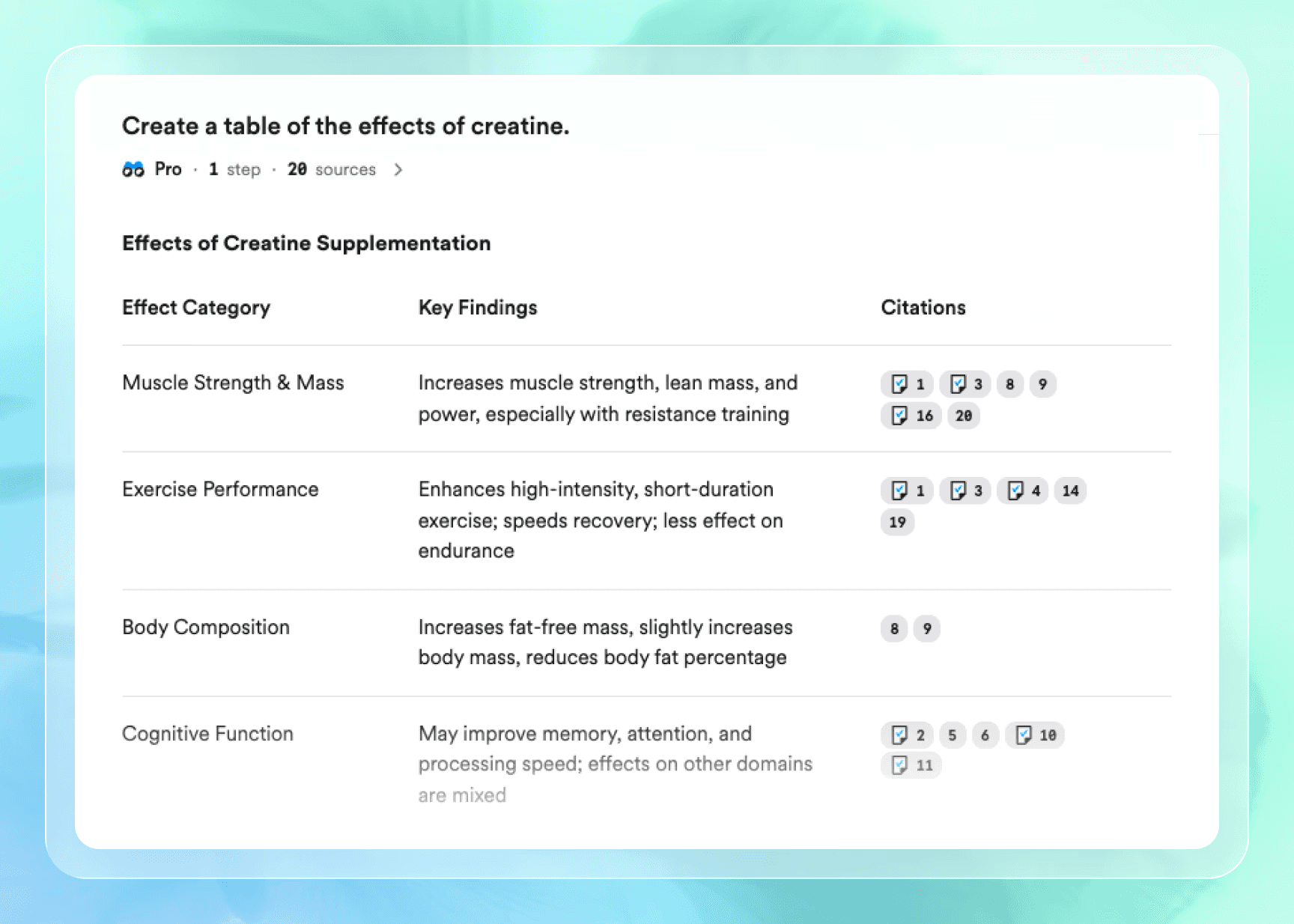
When a students asks, “What are the best resources to organize my scholarly articles as well as to summarize my findings?”, librarians can introduce them to Consensus tables. For example, a table exploring the effects of creatine may include:
Effect Category (e.g., strength gains, cognitive outcomes, recovery rates)
Key Findings (summaries of what the literature shows)
Citations (with direct links to PDFs or study pages)
This format provides a visually intuitive, academically structured way to manage research evidence, making it easier for students to move into the writing and synthesis phases of their work.
08
Room for Collaboration: Share your results with students, faculty, and fellow researchers
Collaboration and Privacy
As patrons progress through their research, they often need to save their work, share it with collaborators, or maintain confidentiality depending on the sensitivity of their topic. Consensus provides flexible sharing and privacy controls that help students, faculty, and research teams manage their work responsibly throughout the research process.
These features are especially important in academic environments where projects may involve sensitive data, unpublished ideas, or collaborative drafting across multiple stakeholders.
Scenario
You’re currently working with a biology professor who has collected articles on a sensitive topic and wants to keep them private until publication
Librarian’s Solution
The thread visibility options let you make it private, public, or share the thread link on social media platforms like X. Overall, the export feature enables patrons to share their research results easily. Conversely, it allows other patrons to keep their search results private.
Alternatively, if the faculty member is collaborating with colleagues, the librarian can show them how to generate a shareable thread link, allowing trusted collaborators to access the results without making the project public.
Consensus also offers straightforward export options, enabling patrons to save their research summaries, tables, or Deep Research outputs for use in external writing tools, presentations, or lab meetings.

09
Conclusion and Key Takeaways
Overall, the librarian's role in gathering credible resources and teaching information and data literacy is now more critical than ever! As generative AI tools continue to evolve, librarians remain uniquely positioned to help patrons navigate these technologies responsibly, evaluate the quality of information, and apply research literacy skills across academic and professional contexts. As librarians, some of the key challenges we face are understanding which generative AI platforms to use.
Consensus serves as a powerful complement to traditional library databases by providing transparent access to peer-reviewed evidence, guiding patrons through structured research workflows, and supporting tasks such as literature reviews, evidence synthesis, and collaborative inquiry. When used intentionally, it strengthens the librarian’s ability to teach information literacy, data literacy, and AI literacy in a unified way.
How to Use This Playbook
This guide can support librarians in several core areas of practice:
1
Conducting Reference Interviews
Use the strategies in this playbook to help patrons articulate their research questions and identify the type of evidence they need. Tools like the Consensus Meter and Deep Research can support effective reference interactions.
2
Teaching Reference and Instruction Sessions
In classroom environments, this playbook provides examples and pedagogical strategies to teach patrons how to develop strong prompts, interpret evidence, refine searches, and organize findings. These skills support students across disciplines and degree levels.
3
Collaborating with Faculty and Research Teams
Consensus can assist with complex research processes such as literature reviews, systematic methodologies, and collaborative evidence synthesis. Librarians can use the features highlighted in this guide to demonstrate their expertise and support faculty in integrating AI tools into their research workflows.
Final Note
By combining traditional information literacy principles with the capabilities of AI-driven research tools, librarians can lead the way in helping students and faculty engage with scholarly evidence more efficiently, critically, and confidently. Consensus provides an opportunity to enhance—not replace—the librarian’s professional expertise, offering new pathways to support rigorous, evidence-based inquiry.
Become a Consensus MCP expert.
For courses and more information on how to use the MCP, check out our guide below.