Writing Literature Reviews with AI
Writing Literature Reviews with AI
A step-by-step approach for researchers, postgraduate students, and academics

Dr. Benita Olivier
Professor of Rehabilitation Oxford Brookes University
What is a literature review and why does it matter?
Every groundbreaking research journey starts with a simple question, but before collecting data, you need to understand what's already known. That's where a literature review becomes your academic compass.
A literature review is far more than summarising articles.
It's a critical synthesis of existing knowledge that serves as the foundation for your research contribution.
Your literature review should accomplish five key objectives:
Provide essential background context on your research topic
Highlight the specific problem your research addresses
Identify gaps in current understanding
Justify the significance of your proposed work
Establish appropriate methodology and outcome measures
The payoff
Done well, your literature review frames your study as an essential next step in the ongoing academic conversation. Done poorly, your research risks floating without a scholarly anchor.
A strong literature review demonstrates you've looked widely and thought deeply. It balances breadth (covering the relevant research landscape) with depth (engaging critically with key studies).
Here's the encouraging news
With a structured approach, smart tools, and the right mindset, this process becomes entirely manageable. Modern AI-powered platforms like Consensus can save time, maintain focus, and uncover insights faster than ever before.
This guide walks you through the complete process
1
Planning strategically
2
Searching efficiently
3
Processing critically
4
Writing confidently
5
Polishing professionally
6
Celebrating your significant achievement
Time investment here saves hours of frustration later
Successful literature reviews begin long before you download your first PDF. Strategic planning sets you up for clarity, focus, and sustained momentum throughout the process.
Create your structural framework
Think of explaining your project to a colleague in a lift conversation. What are the 3-5 essential themes you'd cover? These become the skeleton structure of your review. Refinement comes later - start with a clear roadmap.
Tools like ChatGPT, Gemini, or Claude can suggest potential outlines based on your research aims and objectives. You're not obligated to accept every suggestion, but AI provides valuable structural inspiration.
Visualise with concept mapping
For visual thinkers, mapping themes using Lucidchart, Miro, or even whiteboard sketches reveals connections between research areas. Seeing topic relationships makes logical grouping significantly easier.
For example, a student researching "digital health interventions for diabetes management" identified themes that included intervention types, patient outcomes, technology barriers, and implementation strategies. This visual exercise clarified their entire review approach.
Learn from exemplars
Browse your university's thesis repository or search Google Scholar for dissertations in your field. Pay attention to:
Topic inclusion patterns relative to research aims
Structural flow and logical progression
Creative presentation tools like summary tables and visual frameworks
Productivity strategies that work
Literature reviews can feel overwhelming, and these productivity techniques may help:
Use timeboxing and writing retreats to create protected time
Schedule deep work blocks when your cognitive energy is highest
Tackle challenging sections first during peak mental clarity
End each session strategically by noting down tomorrow's specific next steps
Set realistic daily targets rather than overwhelming yourself with unrealistic expectations
Where to search systematically
Traditional academic databases:
PubMed for biomedical and health sciences research
Web of Science for multidisciplinary coverage and citation tracking
Scopus for comprehensive scientific literature across disciplines
There are many more out there, so speak to your librarian
Search engine:
Google Scholar for broad coverage
AI-powered research acceleration:
Consensus: Delivers evidence-based summaries with synthesis across multiple studies
Balance historical foundations with current insights
Focus on recent studies (last 3-5 years) to capture the current state of knowledge, but don't ignore seminal works that shaped your field, even if published 10+ years ago.
Avoid the research rabbit hole
The internet offers endless fascinating tangents. Keep your research question visible on your workspace to maintain focus. When interesting but tangential papers appear, save them in a "future reading" folder rather than getting sidetracked.
Document your search strategy
Create a searchable record including:
Databases and keywords used for each search
Filters applied (date ranges, study populations, methodology types)
Number of results and your selection criteria
Rationale for inclusion/exclusion decisions
Organise sources like a professional
File management that scales:
Consistent naming convention: Surname_Year_ShortTitle (e.g., Smith_2023_DiabetesIntervention)
Thematic folder organisation by research sub-questions
Backup systems (cloud storage plus local drives)
Reference management software: EndNote, Mendeley, or Zotero for citation tracking
1
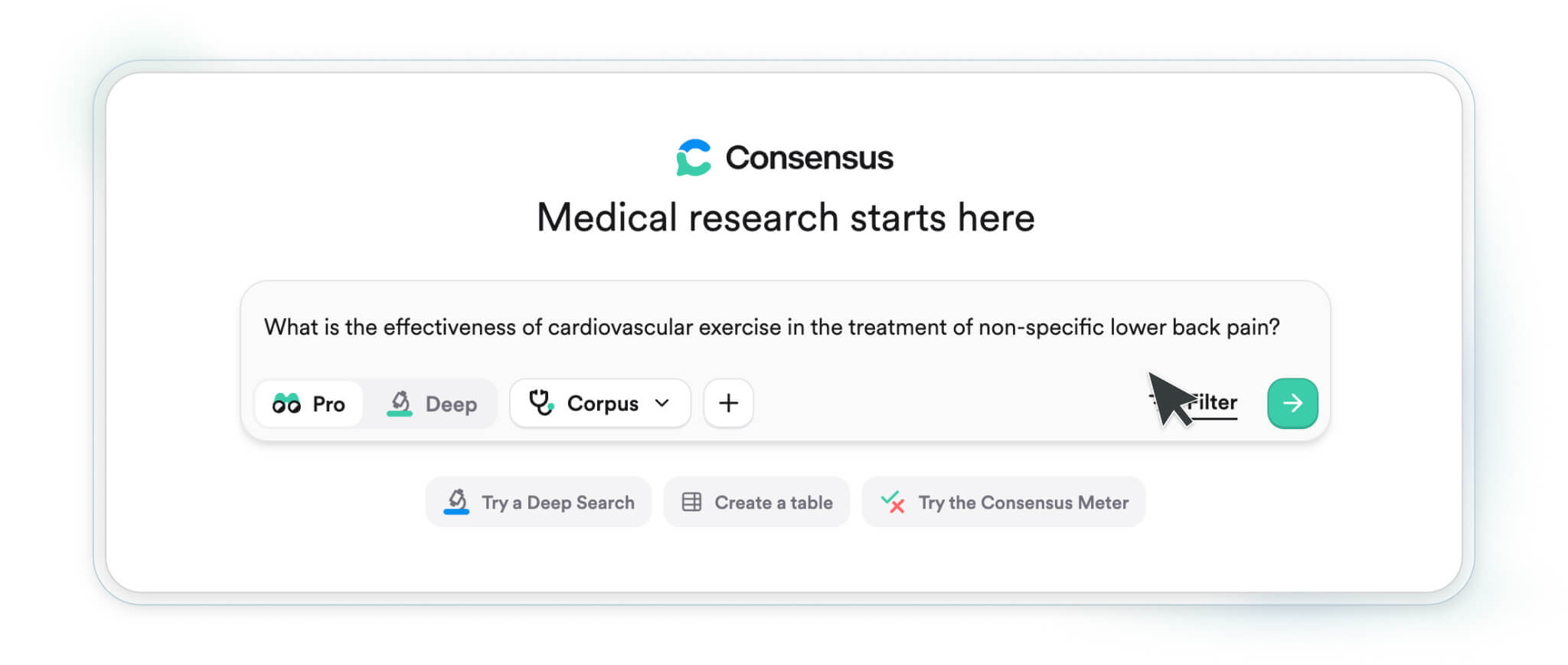
Start with a focused research question
Input a research question into the search bar, e.g., “What is the effectiveness of cardiovascular exercise in the treatment of lower back pain?”
2
Select your search mode based on your needs:


3
Narrow results with filters
Use the Filter to limit the search to more recent studies, if you prefer.
4
Switch to Medical for clinical research
If you are doing research in the medical field, change "All" to "Medical" and Consensus will access about 8 million high-quality studies from top medical journals and guidelines.
5
Run the search and review the output
Click the arrow, go make a cup of tea and allow your Consensus to do what it’s best at.
Step 3 cont.
Smart AI application:
Use Consensus for rapid evidence synthesis across multiple studies
Critical caveat: AI provides speed and pattern recognition; you provide critical judgment and interpretation. Never accept AI outputs without verification and contextual analysis.
Compare, contrast, and critique
Your literature review should reveal patterns, contradictions, and insights rather than simply reporting individual study findings.
Strong synthesis example
"While Johnson et al. (2023) demonstrated significant improvements in patient adherence through mobile health interventions, Williams (2022) identified substantial implementation barriers in resource-limited settings. Together, these findings suggest that technological solutions require careful adaptation to local contexts..."
This approach showcases your analytical voice while weaving together complex research findings.
Three-tier screening approach:
1
Title and abstract screening
Is this directly relevant?
2
Methods and results skimming
Does the methodology fit your focus?
3
Full-text deep reading
Only for studies central to your argument
Create comprehensive article tracking using structured templates.
Essential fields to capture:
Author, year, and complete title
Research question or primary hypothesis
Methodology (design, sample size, measures, analysis approach)
Key findings and effect sizes
Study limitations and researcher-identified gaps
Your assessment of relevance and quality

Understanding the Analysis Summary
When you run a search (especially in Pro or Deep mode),
Consensus provides a comprehensive analysis before showing individual papers:
1
Introduction/TL;DR:
Start here for a quick overview of what the research says about your question. This summary is tempting to copy-paste, but resist! Use it to understand the landscape, then dive deeper into the actual studies.
2
Consensus Meter:
This visual shows which direction the research findings lean (e.g., "Yes," "No," or "Possibly"). While helpful for getting a quick sense of the field, don't treat it as absolute truth. It's a crude measure—a proper systematic review uses advanced statistics to weight each study. Still, it's a useful starting point.
3
In-line Citations:
• Citation numbers link directly to supporting research papers
• checkmark = full text was analyzed
• No checkmark = only abstract was analyzed
• Click any citation to view paper details or access the full paper
4
Visualizations (appear automatically based on your query):
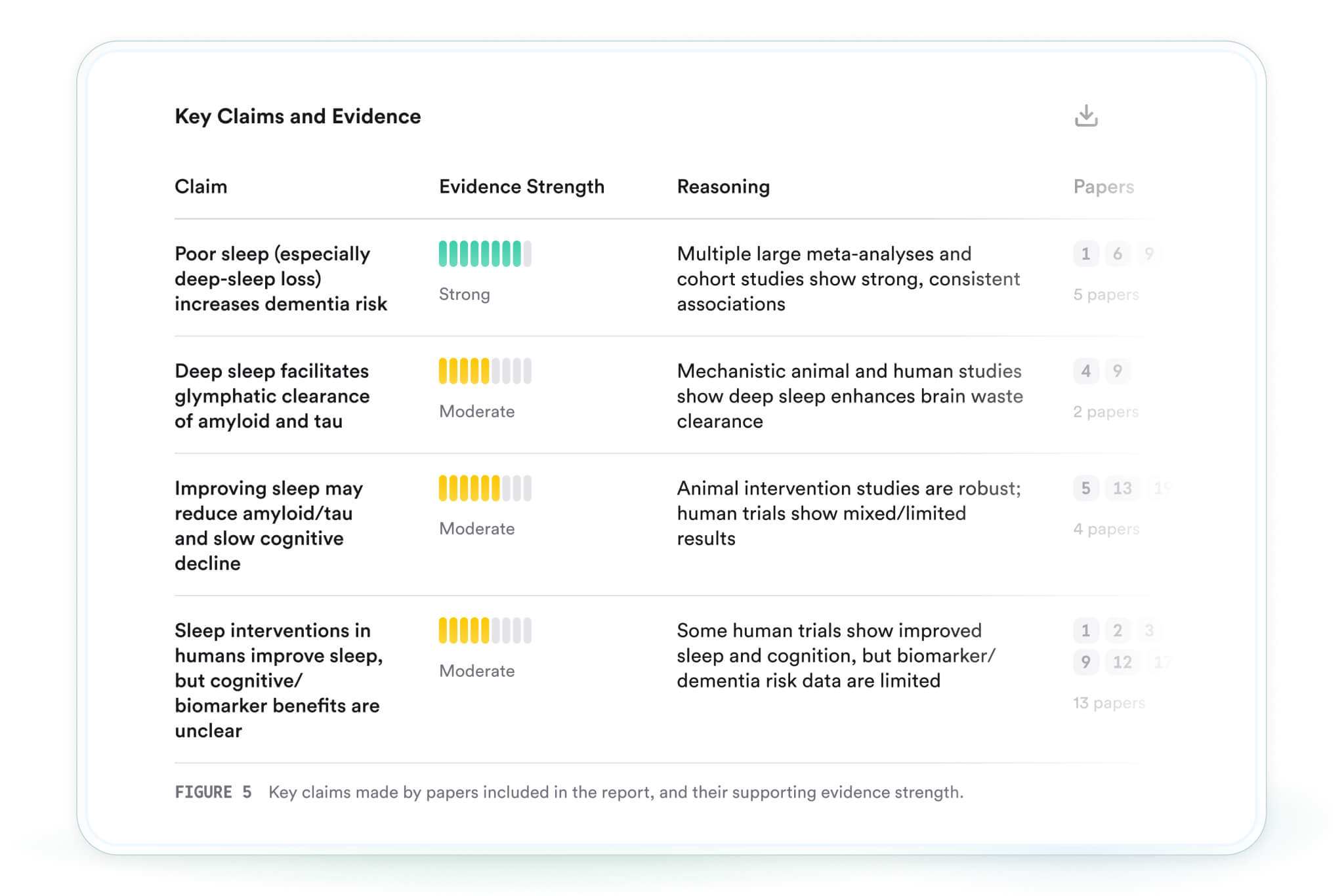
Claims & Evidence Tables:
Key claims with supporting evidence—perfect for building arguments in your literature review
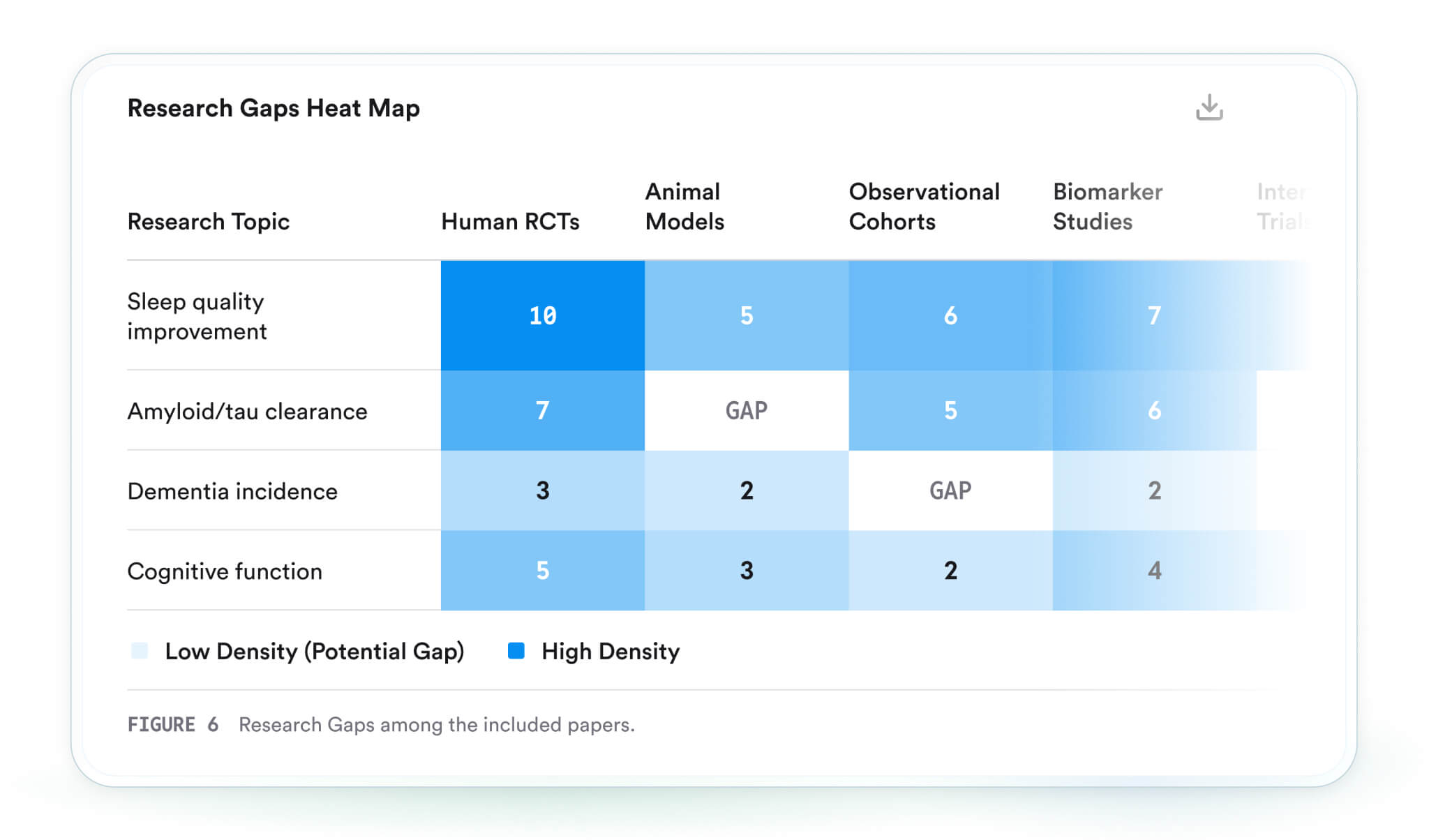
Research Gaps Heat Maps:
Identifies understudied areas (great starting point, but always review papers yourself to identify additional gaps)
Results Timeline:
Shows publication patterns over time
5
Methods Section:
Take a moment to review how Consensus generated your results. Understanding the methodology helps you appreciate (and critically evaluate) the output.
This is where the magic happens! Here's how to make the most of it:
1
Thematic Organization:
Studies are categorized under headings—these themes will likely feature in your own literature review structure.
2
Download & Export:
• Download the studies under each heading
• Use the Export button at the bottom to add references
directly to your preferred reference management software
• Save, read, and cite them in your literature review
3
Track Key Researchers:
Notice who's publishing frequently in your field. These are the role players you should follow—and someday, you might be one of them!
4
Evidence Strength:
Always review the Evidence Strength yourself using your critical appraisal skills. Consensus provides a starting point, but your expertise matters.


Transform organised notes into a compelling narrative
With systematic summaries complete, you're ready to craft your literature review. The key is building momentum through manageable progress rather than pursuing immediate perfection.
Avoid "blank page paralysis"
Choose your strongest theme to begin writing
Free-write initial thoughts without editing concerns
Insert citation placeholders for later formatting
Build your review incrementally, section by section

Momentum trumps perfection in early drafts.
Refinement comes during revision phases.
Appropriate AI applications:
Overcome writer's block with paragraph starters or structural suggestions
Generate transition sentences between major sections
Suggest alternative phrasing when you're stuck on expression
Check grammar and clarity during revision phases
Maintain academic integrity
Your critical analysis, interpretation, and argumentation must be entirely your own work. AI assists with mechanics, not intellectual contribution.
Proven strategies:
Take strategic breaks when feeling stuck—solutions often emerge during walks
Set micro-goals: 200 words before lunch, one paragraph before coffee break
Use the Pomodoro Technique: 25-minute focused work bursts with 5-minute breaks
Remember the mantra: Rough drafts beat perfect paralysis every time
Focus on completion over perfection
Many researchers get trapped in premature polishing. Instead, draft first, then refine:
Complete your full first draft with all major sections
Review overall structure and logical flow
Polish individual paragraphs and sentence-level clarity
Perfect citations and formatting as final steps
The polishing phase
The polishing phase elevates your literature review from a functional draft to a credible academic work. Attention to detail here makes the difference between good and exceptional reviews.
Perfect paragraph structure
Each paragraph should follow a proven structure:
Topic sentence introducing the main point clearly
Evidence presentation with appropriate citations and analysis
Synthesis statement connecting findings to your research objectives
Transition preparation linking to subsequent arguments
Ensure narrative coherence
Your literature review should read like a compelling story rather than a series of disconnected summaries.
Check transition quality between sections:
Effective transition example
"While the previous studies demonstrate clear intervention benefits, they also reveal significant implementation challenges in real-world settings. The following section examines these practical barriers in detail..."
Professional formatting essentials:
Consistent referencing style (APA, Harvard, Vancouver) throughout
Clear hierarchical headings guiding readers through your argument
Citation accuracy with in-text references matching bibliography
Professional table and figure presentation if applicable
Technology-enhanced revision:
Grammarly or Paperpal → Grammar, clarity, and tone refinement
Hemingway Editor → Identifies overly complex sentences
Acknowledge the substantial intellectual work you've completed
Writing a comprehensive literature review represents a major academic accomplishment. It requires sustained focus, critical thinking, analytical synthesis, and scholarly persistence.
Recognise your growth
Through your literature review you have:
Established expertise in your research area
Developed critical analysis skills transferable to other projects
Created scholarly foundation for your empirical work
Joined academic conversation in your field
Every completed literature review strengthens both your current project and your long-term research confidence. You've contributed your analytical voice to ongoing scholarly dialogue, and that represents genuine academic achievement worth celebrating.
Writing literature reviews doesn't have to feel overwhelming. With systematic planning, efficient tools, and strategic AI assistance, you can transform the research process into manageable, rewarding intellectual work.
Modern AI platforms like Consensus accelerate your research without replacing your critical thinking. They help you discover relevant studies faster, extract key insights efficiently, and identify research patterns systematically, while you provide the analytical framework that makes literature reviews valuable.
Your next step:
Begin with strategic planning
Map your research themes
Identify key databases
Start building your systematic approach to literature review excellence
Become a Consensus MCP expert.
For courses and more information on how to use the MCP, check out our guide below.