

A blank table isn’t a dead end. It’s where your next question might be hiding.
The Research Gaps Matrix helps you see where attention is concentrated — and where the literature retrieved for your question might be thin. Now, the Research Gaps Matrix is just the start: click to open any cell to and start to investigate the papers cited and the exact passages that put them there.
If a cell is empty, send that gap directly to Deep. Consensus takes you from a broad question, to a map of the evidence, to the next question worth investigating without starting over.
From question to evidence map
Starting research is often an orientation problem. You have a rough question and a field you only partly know. Before you can form a hypothesis or design a study, you need to understand what researchers have examined, where the evidence clusters, and which directions might deserve a closer look.
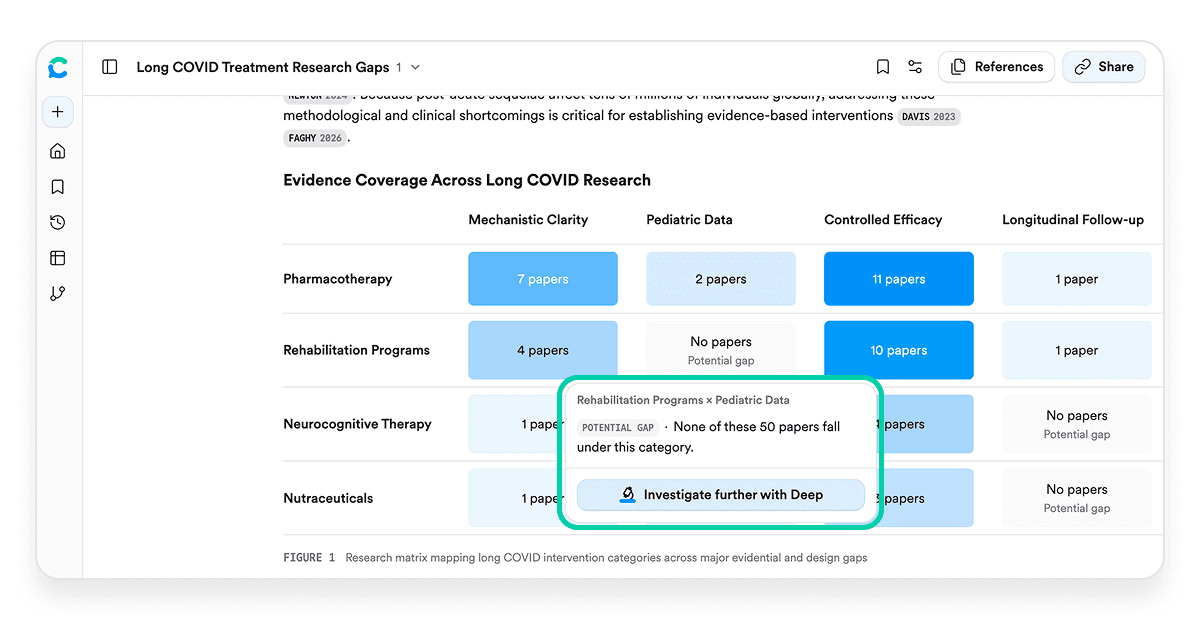
Ask Consensus about gaps in an area and it builds a coverage grid from the papers retrieved for your question. Sub-topics run down one side, research dimensions across the top, and each cell shows how many papers sit at that intersection. Dense cells reveal where attention has gone. Sparse ones point to questions worth investigating.
Until now, that was where the matrix stopped. A cell could tell you that two papers covered a topic, but not which two — or what in those papers justified the placement. It was useful for orientation, but we knew researchers wanted to go deeper: to shape a literature review, proposal, or study.
Map, verify, investigate
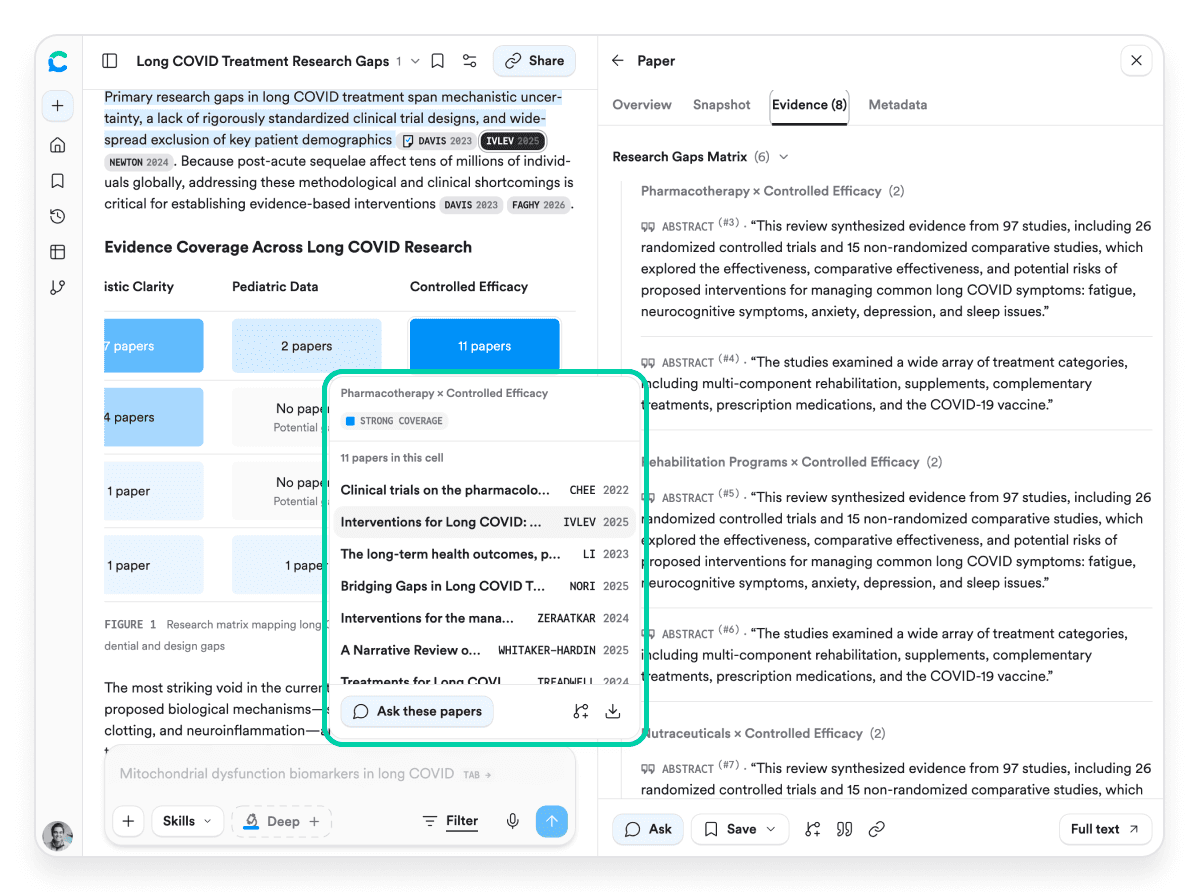
Open any cell. Hover to see the category, its coverage level, and the papers inside it, listed by author and year. Click a paper and it opens beside the matrix with the exact passage behind its placement highlighted in the text.
Review the evidence. The paper's Evidence tab collects every quote used by the matrix, grouped by the cell it supports and labelled by where it came from—the abstract or full text. You can check the reasoning in one place instead of treating a count as a conclusion.
Investigate what looks thin. An empty cell is marked “Potential Gap”. Choose Investigate further with Deep and Consensus turns that row-by-column intersection into a focused search. A gap in the current set of papers becomes the next question you can test, not proof that no research exists.
Two ways to use it
1. Get oriented in an unfamiliar field
The first hour in a new literature is mostly triage. Instead of reading several reviews just to reconstruct the shape of a field, use the matrix to see where research activity clusters and which papers are worth opening first.
The same process can challenge assumptions in a field you already know. Areas that feel well studied are not always the ones with papers behind them. And now you can inspect the evidence rather than trusting the shape of the grid.
Try it → What are the research gaps in the use of AI in higher education?

2. Turn a potential gap into your next research question
A sparse cell is a candidate, not a finding. Open it, read what justified each placement, and decide whether the thin coverage looks meaningful or reflects how the original question was framed.
Then send the intersection to Deep. Instead of translating the grid back into search terms and starting over, you move directly from orientation to a focused investigation. That makes the matrix useful not just for seeing the literature, but for deciding where to go next.
Run the long COVID example and look at the pediatric row. Open one of its sparse cells, inspect the supporting papers, and hand the question to Deep. In a few clicks, a broad topic becomes a study-shaped question grounded in the literature.
Try it → What are the research gaps in long COVID treatment?

Consensus is where researchers can begin with a broad question, understand the shape of the evidence, and move toward a defensible next step. Start with a question. See where the literature looks thin. Check the papers behind it. Then send the most promising direction to Deep and keep moving.
Start a search on your own topic →