
The Next Breakthrough Should Be Visible on Day One
The American Association for the Advancement of Science publishes a short list of scholarly journal titles: Science, Science Advances, Science Immunology, Science Robotics, Science Signaling, and Science Translational Medicine. But pound for pound, there may be no denser concentration of consequential research anywhere in science.
Today, we're announcing a partnership with AAAS to bring that work into AI-native discovery for the research community.
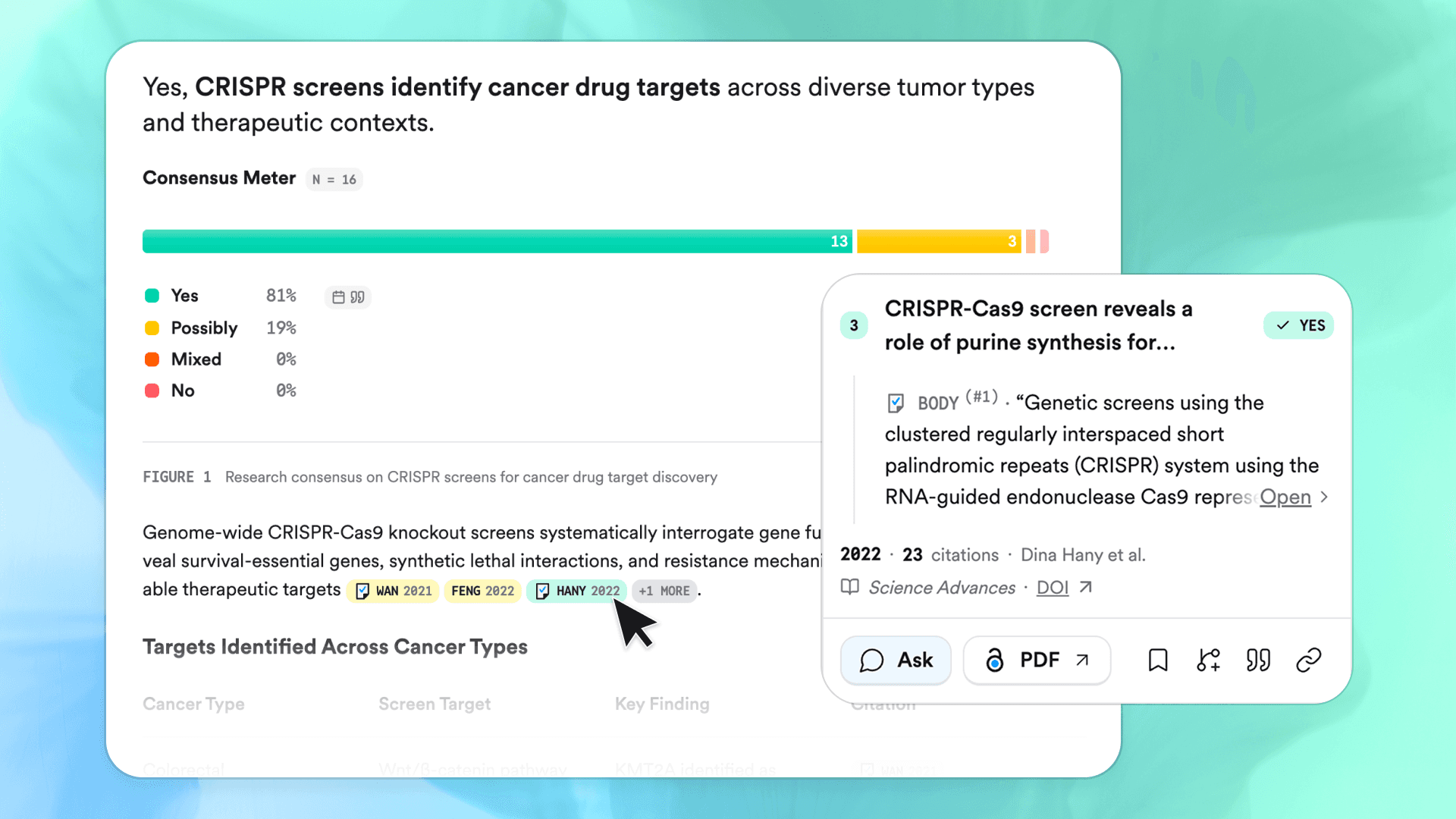
Through this partnership, AAAS is enabling Consensus to index and run AI analysis across the full text of its journals. This content won't be used to train AI models. It powers search and analysis features, and every result in Consensus is built to route readers back to the original work. This means more traffic and more eyeballs to the Science family of journals and its authors, not around them.
The original article remains the authoritative source, reflecting AAAS’s deliberate approach to AI in scientific publishing: embracing new tools where they can improve discovery while maintaining the quality and traceability of the scientific record.
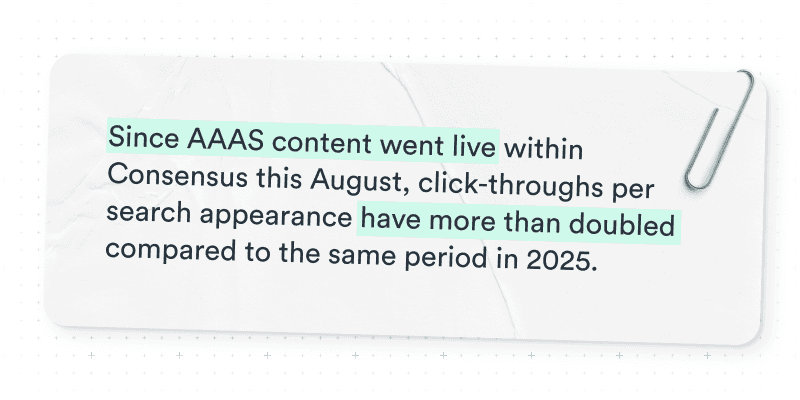
The preliminary result: Since AAAS content went live within Consensus this August, click-throughs per search appearance have more than doubled compared to the same period in 2025.
AAAS is joining a growing, long roster of publisher partners. This is due in large part because Consensus has become a significant source of referral traffic for our partners. Consensus now serves more than 10 million users, making us the most-used academic search tool in the world outside of PubMed and Google Scholar. For many publishers, we drive more traffic than general-purpose AI assistants like Claude and Gemini that don’t have discovery at the core of what they have built.
A Small Catalog, an Outsized Share of the Turning Points
Pick a moment where a field changed direction and there's a good chance Science was there. PCR. Green fluorescent protein. The isolation of HIV. The Celera human genome. CRISPR-Cas9 as a programmable tool, and then Cas9 working in human cells. Every December, Science names a Breakthrough of the Year, highlighting research that helped change the course of modern science – and the archive reads like a map of where modern science actually turned.
That's the catalog we're indexing. Not volume, but value. Having the fullness of this catalog allows the next generation to build on these findings and pursue the next breakthrough that our society rests on
Why Visibility Now Decides What Gets Built On
Researchers are moving to AI tools, fast. For a growing share of researchers, the first move on a new question isn't a database, it's a chat box. That shift is already reshaping how scholarship gets found, and it changes what "published" means in practice.
A paper that AI tools can't see is less likely to appear in the answers researchers increasingly use to begin their searches.
The stakes are highest for exactly the kind of work AAAS publishes. When a paper redirects a field, every month it stays invisible to the tools actually used by researchers today is another month the field evolves slower. That lack of visibility is citations that don't happen, experiments that get run twice, and connections nobody makes.
It’s valuable time that the community is not clued into underlying data and code it may be eager to use. AAAS is making sure that doesn't happen to the work it puts its name on. The next breakthrough published in Science will now be visible to AI-native research from the day it appears.
We Are Betting on Discovery, Not Extraction
Comprehensiveness can't come at the expense of the people who create and publish the work. AI tools have to be built as on-ramps to content, not as machines that absorb it and answer around it.
As the early numbers indicate,Consensus users aren't stopping at the summary; they're going to the paper. That's the whole design: get scholars to the primary source faster, with full attribution, and send the publisher and the author real readers on the other end. This mechanic is the fundamental way that our partnerships with publisher work
At the core, we think the scholarly ecosystem has a choice in front of it. Publishers and AI platforms can work separately at cross purposes, or they can build the future of discovery together. AAAS made the call we'd hope a 178-year-old scientific society would make: meet researchers where they've already gone.
Researchers get faster, more comprehensive discovery across one of the most consequential bodies of work in science. Authors reach more of the readers their work deserves. AAAS connects with a generation of scholars who use AI-powered research tools by default.
And the next breakthrough gets found sooner.