
Fact-checking your Social Media Feed
Fact-checking your Social Media Feed
A practical guide to testing social media health claims with Consensus

Dr. Benita Olivier
Professor of Rehabilitation Oxford Brookes University
Health and wellness claims travel fast on social media. A confident creator with good lighting and a punchy hook can persuade thousands of viewers that seed oils are toxic, that a specific supplement transforms cognition, or that one particular diet will fix everything from low energy to autoimmune disease. These claims often sound scientific. Some cite a single study. A few even tag a peer-reviewed paper in the description.
The problem is not that the science is being mentioned. The problem is that a single study, stripped of context, is being presented as settled evidence. That is rarely how science works. This guide shows you how to use Consensus to test claims you encounter in your feed: to look beyond the headline and see what the wider body of evidence actually says. The skill it builds is learning to think in terms of evidence rather than anecdotes.
Cherry-picking is the practice of selecting evidence that supports a particular conclusion
while ignoring evidence that contradicts it. It is not always deliberate. Sometimes, a creator genuinely believes their claim because they have only encountered the studies that support it. Sometimes the motivation is more cynical. Either way, the effect on the viewer is the same:
a partial picture presented as a complete one.
Here is what cherry-picking typically looks like in practice:
One small study showing a possible link is cited as proof of causation.
A finding from an animal model is presented as if it applies to humans.
A result from a highly specific population (athletes, people with a particular condition) is generalised to everyone.
Limitations, conflicts of interest, and study design issues are not mentioned.
The dozens or hundreds of studies pointing in a different direction are simply absent from the conversation.

A useful rule of thumb:
any claim that depends on a single study to make its case is, by definition, not yet supported by the body of evidence. It may eventually be. It may not be. You cannot tell from one study.
In evidence-based practice, the strength of a claim is not determined by how compelling a single study sounds. It is determined by what the body of literature looks like when you take a step back.
This is sometimes called the principle of aggregation, which means to know what the evidence actually says, you need to look at multiple studies, ideally including systematic reviews and meta-analyses, and ask:
How many studies have investigated this question?
Do they point in the same direction, or do they conflict?
What are the strongest study designs, and what do they show?
What are the limitations, and where are the gaps?
A claim supported by a single study is interesting. A claim supported by a body of consistent evidence is robust. Learning to tell the difference is the heart of this skill.


When you ask Consensus a yes/no research question, it does not just retrieve papers.
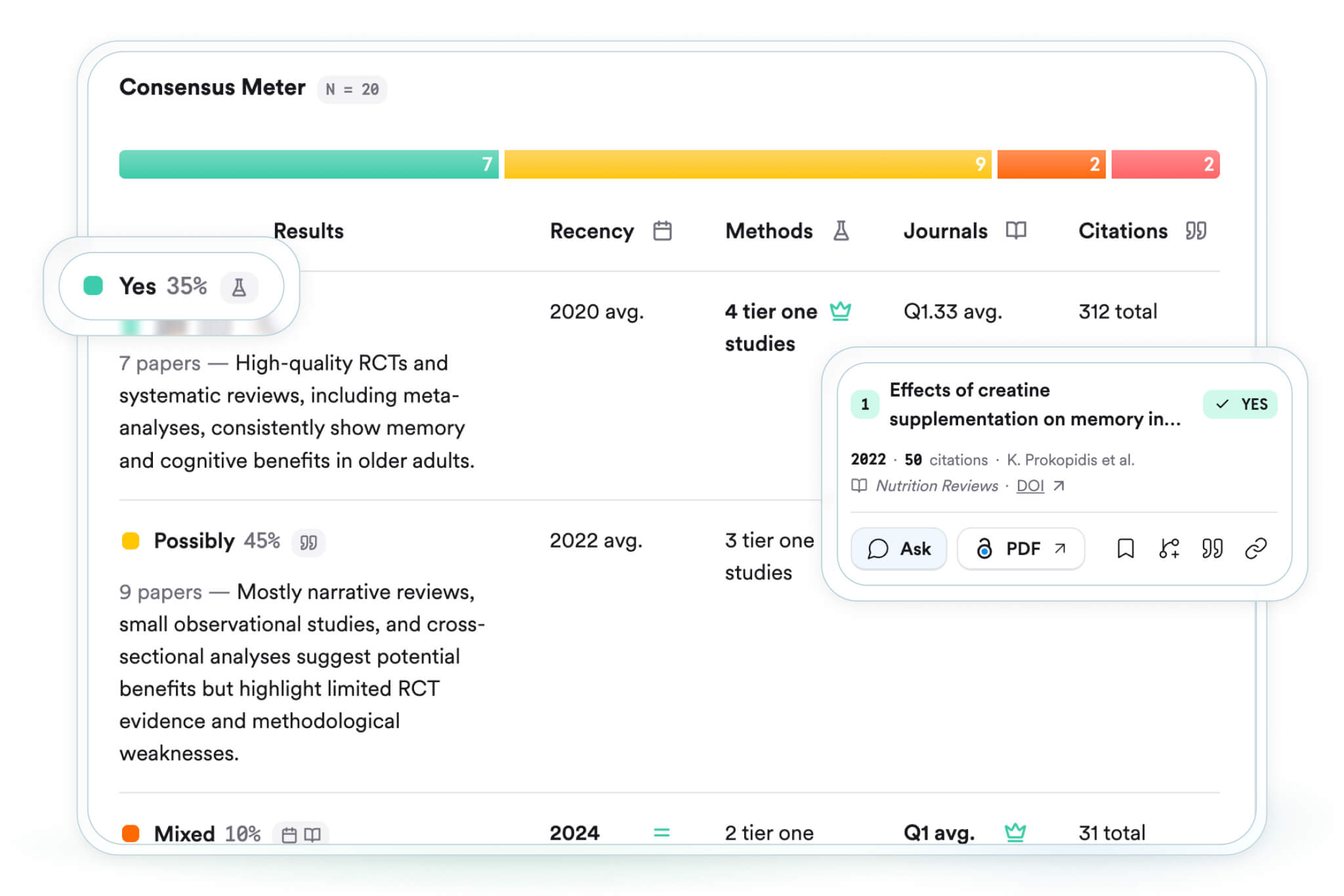
It shows you what the aggregate of those papers says using the Consensus Meter, which displays the proportion of relevant papers that support, are mixed on, or do not support the claim.
This is exactly the view that social media tends to obscure. Where a viral post will show you one study, Consensus shows you many. And where a creator will pick the most striking finding, Consensus shows you the spread.
A few caveats are worth holding alongside this:
The Consensus Meter reflects how individual papers' findings align with your question. It is a useful starting point, not a replacement for a robust systematic review with meta-analyses or a substitute for reading the studies themselves.
A meter showing strong support does not mean a claim is settled. It means the available evidence in Consensus's index leans in that direction. Quality and methodology still matter.
A meter showing mixed or contradictory findings is not a failure of evidence. It often reflects the genuine state of the science, and that is valuable information in itself.
You will still need to read the original papers, especially for any claim you intend to act on, share, or cite. But Consensus gives you something a creator's post cannot: a view of the wider literature.
Let's work through an example using a claim that has circulated widely on social media:
that seed oils are inflammatory and damaging to health.
Turn the claim into a question and add that question to Consensus. The Consensus Meter
requires at least five papers that directly answer your question in order for it to show up.
For example, “Do common dietary seed oils raise systemic inflammatory markers such as CRP, IL-6, or TNF-α in humans?” may not show the Consensus Meter, because there may only be
three studies that investigated this. But a broader question, such as “Are seed oils inflammatory and damaging to health?” will show the Consensus Meter.
Have a look at the Consensus Meter, and read the summary. This will give you a good
overview of what the evidence says about the claim. But don’t stop here. Delve deeper.
A vague claim such as "seed oils are bad for you" is too imprecise to test.
What is actually being claimed?
Usually one of:
Seed oils raise markers of systemic inflammation.
Seed oils contribute to chronic disease (heart disease, obesity, metabolic syndrome).
Seed oils are worse for health than alternative fats (butter, tallow, olive oil).
Each of these is a distinct empirical question. Pick one to test.
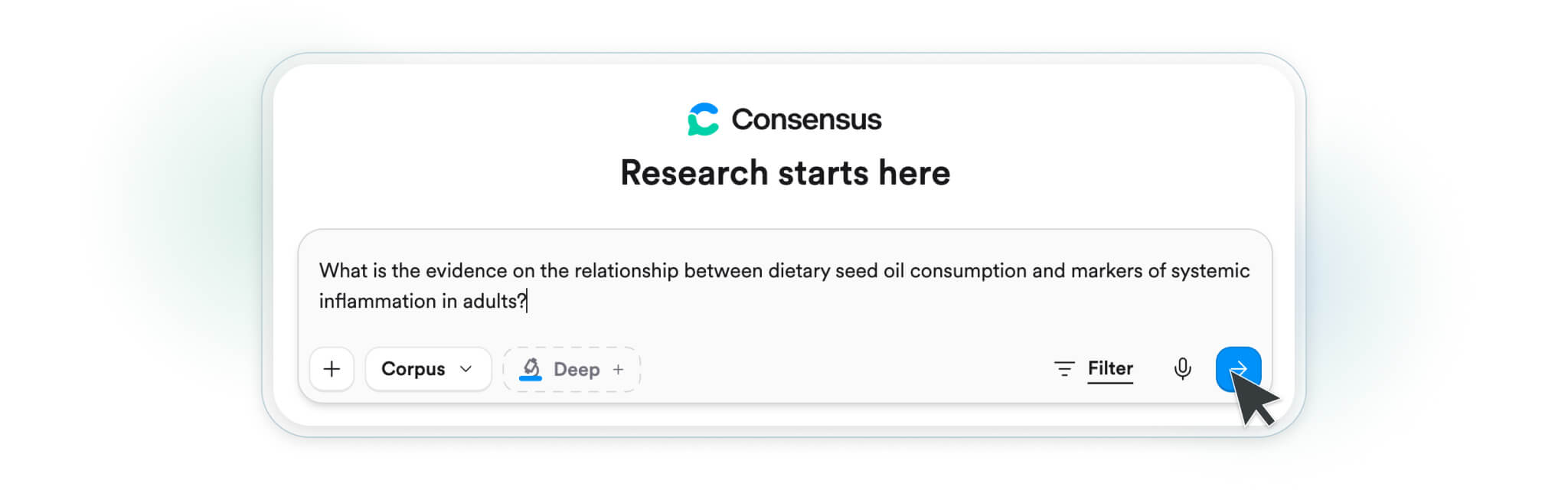
For example, "What is the evidence on the relationship between dietary seed oil consumption and markers of systemic inflammation in adults?" (For more on this, see the companion guide Framing Unbiased Research Prompts.)
Type the question into Consensus.
Click through to the papers themselves and look for:
Study designs (randomised controlled trials, observational studies, or animal studies) – some study designs carry more weight than others.
Any systematic reviews or meta-analyses, which carry more weight than single studies.
Populations studied (healthy adults compared with people who have specific conditions), and whether these correspond with what the claim promotes.
Outcomes measured (inflammation markers, clinical outcomes, or surrogate markers) and how these fit with the claim.
You may conclude that the claim is unsupported, partially supported, contested, or simply that the evidence is too limited to say. Any of those is a legitimate, defensible conclusion.
What you no longer have to do is take the original creator's word for it.
Use this table to recognise when a claim deserves a second look.
Red flag | What it suggests | What to do |
|---|---|---|
Cites one study with great confidence | Likely cherry-picked from a wider, more mixed literature | Search the topic in Consensus and read the meter |
Uses absolute language ("toxic", "destroys", "miracle") | Overstates findings that are almost always more nuanced | Reframe as a neutral question and check the evidence |
Generalises from animal or in vitro studies to humans | Effects in cells or animals do not always translate to people | Look for human studies on the same question |
Presents a finding from a | Results in athletes, patients, or particular groups may not generalise | Check whether the study population matches the population being advised |
Recommends a product the creator sells or promotes | Conflict of interest | Read the underlying study independently |
Does not mention conflicting evidence | The body of literature is being ignored | Search Consensus for the whole picture |
Frames complex science as a "truth they don't want you to know" | A persuasive narrative, not an evidence claim | Treat the framing as opinion, then check the actual evidence |
Once you have tested a claim, you may want to respond to the original post or share what
you found with others. This is worth doing, and worth doing well. A response that is generous
and grounded in evidence does far more good than a combative correction, which tends to
make people defensive rather than curious.
Lead with the evidence. Showing people the body of literature is more persuasive than telling them they are wrong.
Stay curious rather than contemptuous. The aim is to widen the conversation, not to win it.
Be honest about uncertainty. If the evidence is genuinely mixed, say so. That honesty is what sets your response apart from the original claim.
Hold your own conclusion lightly. Now and then, the evidence will surprise you, and you will be the one updating your view.
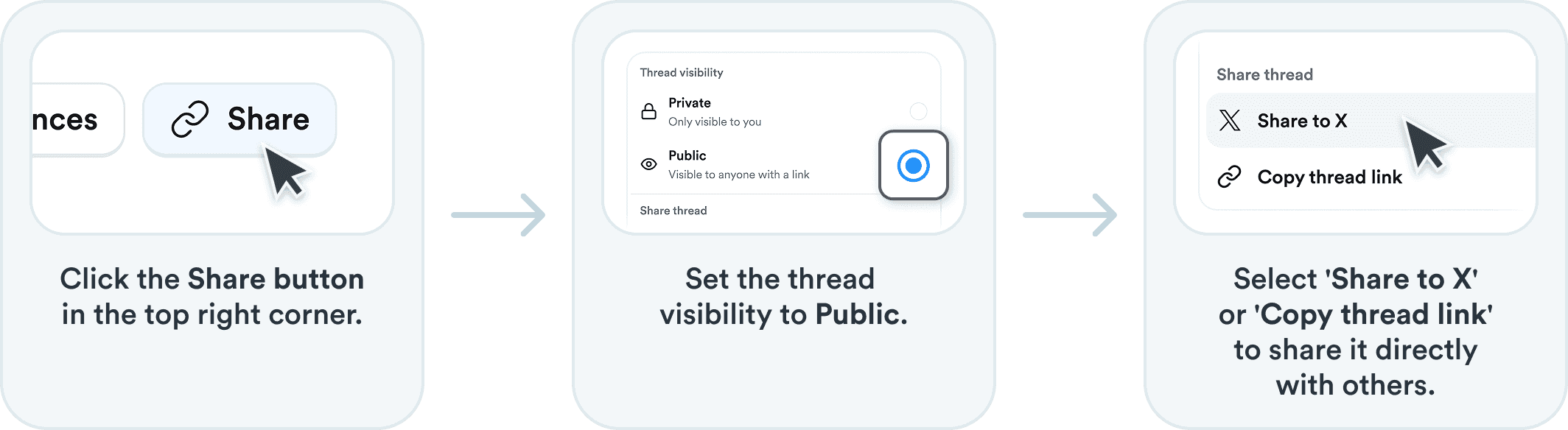
Consensus makes the evidence easy to share directly. Once you have run a search and read the underlying papers, you can share the thread so that others can see the same body of evidence you did.
A final thought
The ability to test a claim against the wider evidence is one of the most useful research skills you can develop. It applies to your studies, to your clinical practice, and to the conversations you have with friends, family, and patients about what the science actually says.
Social media rewards confidence. However, the evidence is the more reliable guide.
Become a Consensus MCP expert.
For courses and more information on how to use the MCP, check out our guide below.